How to Read a Greyhound Racecard: Form Guide Explained
Best Greyhound Betting Sites – Bet on Greyhounds in 2026
Loading...
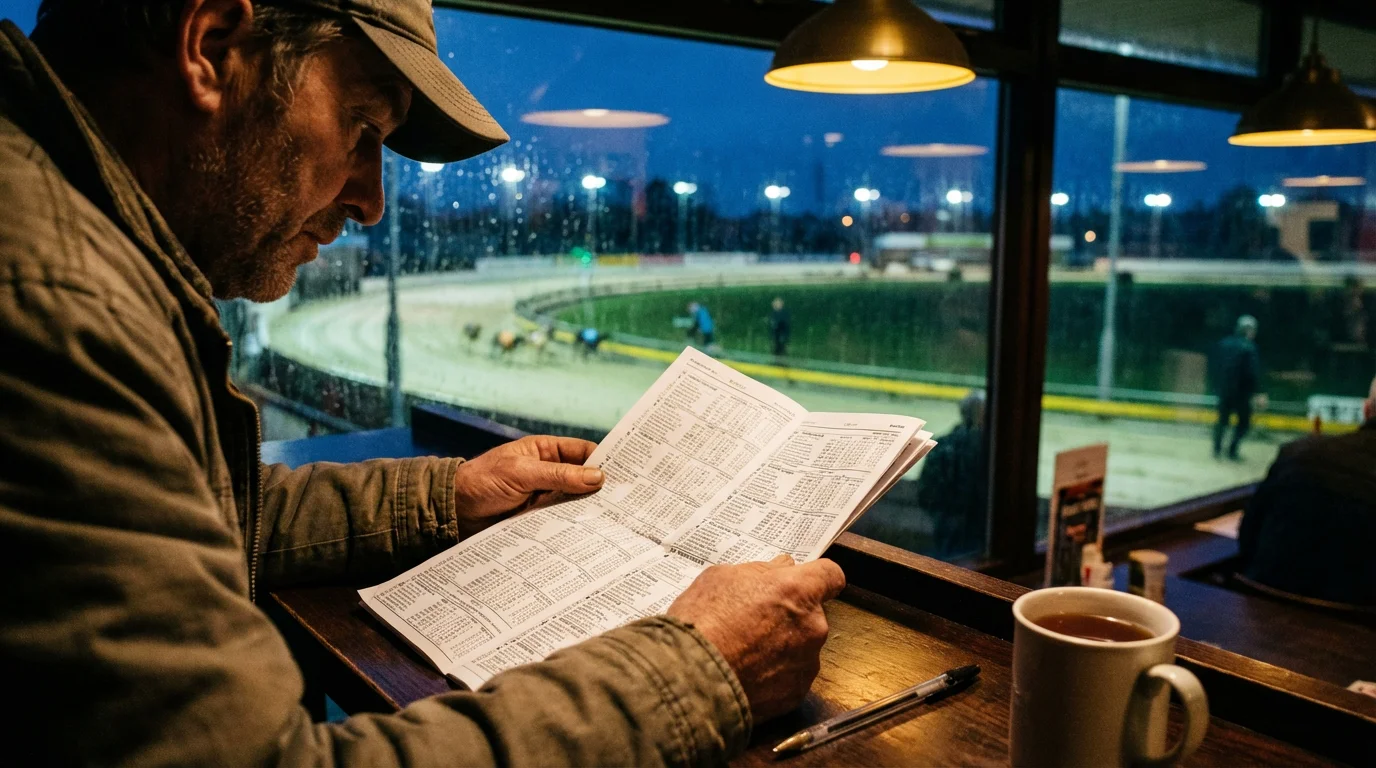
A greyhound racecard packs more usable data into one page than most sports give you in an entire broadcast. Every runner’s recent history, every trap draw, every split time and finishing position sits there in condensed form, waiting to be read. The problem is that most people glance at it, pick a name they like, and move on. That is not reading a racecard. That is decoration.
This guide treats the racecard as what it actually is: a diagnostic tool. If you can read one properly, you can assess a six-dog field in under five minutes and walk into any UK greyhound meeting with a genuine information edge. If you cannot read one, you are relying on instinct in a sport that punishes instinct with mathematical regularity.
We are going to break the card down piece by piece. Header information, runner profiles, form lines, abbreviations, split times, calculated times and the going correction that makes comparison possible across different nights and different tracks. By the end, you will know what every column means, what it tells you about the dog, and how to turn that knowledge into sharper betting decisions. No fluff, no shortcuts, no jargon left unexplained.
Anatomy of a Greyhound Racecard
Every racecard follows the same structure — learn it once, read any track. Whether you are looking at a Monday afternoon meeting at Romford or a Saturday night card at Towcester, the layout and information hierarchy remain consistent across all GBGB-licensed venues in the UK. That consistency is a gift. Once the structure clicks, you stop searching for data and start interpreting it.
A standard UK greyhound racecard is divided into two layers. The first is the race header, which tells you the basic parameters of the event: when it starts, how far they run, and what level the race is pitched at. The second layer is the runner information, repeated six times for a standard race — one block per dog. Each block contains the dog’s identity details, its recent form lines, and a set of performance figures that, read correctly, give you a surprisingly detailed picture of what that animal has done in its last handful of outings.
The mistake most newcomers make is treating these as separate pieces of information. They are not. The header frames the context — distance, grade, track — and the form lines only make sense within that frame. A 16.75-second split time means something very different over 480 metres at Sittingbourne than it does over 500 metres at Hove. The racecard is a system, and you need to read it as one.
Think of the racecard as a compressed scouting report. In horse racing, you might spend twenty minutes reviewing a single runner’s profile on a form site. In greyhound racing, the card itself does that job — if you know where to look. Let’s start at the top.
The Header: Race Information at a Glance
The header tells you what race you are looking at before you look at a single dog. It sits at the top of every race block and contains five core pieces of information: the off time, the race number within the meeting, the distance in metres, the grade classification, and the prize money. Some racecards also show the race type — flat, hurdles, or marathon — and whether it is a graded, open, or special event.
Distance and grade are the two header elements that matter most for betting. Distance tells you the physical demand of the race — a 285-metre sprint is a completely different athletic test from a 480-metre standard or a 700-metre staying event. Dogs have distance preferences just as clearly as human athletes do, and a dog with excellent sprint form may fall apart over four bends. Grade tells you the quality of competition. A1 is the highest graded tier at most tracks; D4 is the lowest. When a dog’s recent form shows it winning at A4 and it is now running at A2, the step up in class is a critical factor that raw times alone will not reveal.
Prize money matters less for betting analysis, but it gives you a proxy for race importance. Higher-value pots tend to attract dogs in peak condition. Trainers do not waste a peaking dog on a low-grade Tuesday night card if they have a better option on Saturday.
Runner Details: Name, Trap, Trainer and Breeding
The dog’s profile is your first filter. Beneath the race header, each runner gets its own block, and the top line of that block tells you the basics: trap number, trap colour, the dog’s name, and — in most formats — its colour, sex, sire, dam, and the name of the trainer.
Trap number determines starting position, and it matters far more than casual punters realise. Traps are numbered 1 through 6, running from the inside rail outward, and each corresponds to a jacket colour: red for 1, blue for 2, white for 3, black for 4, orange for 5, and black-and-white stripes for 6 (as set out in GBGB Rule 118). A railer drawn in trap 1 has a natural advantage; a wide runner squeezed into trap 2 may spend the first bend fighting for room. We will return to this when we discuss form analysis, but for now, register that the trap number is not random decoration.
The trainer’s name is worth noting too. Certain kennels have strong track-specific records, and a trainer who consistently sends dogs to a particular venue tends to know that track’s quirks. Breeding information — sire and dam — is useful for longer-term assessment of distance suitability and running style, though it rarely changes your view of a single race. Age and sex are listed in abbreviated form: d for dog, b for bitch, followed by a colour abbreviation like bk for black or wbe for white-and-brindle. All useful context. But the real substance sits below.
Reading the Form Lines
Six lines of form. Six races’ worth of data. Every column tells a different part of the story. The form section is the heart of the racecard, and it is where most people either develop an edge or give up and guess. Each line represents one recent race, listed in reverse chronological order — the most recent run sits at the top.
A typical form line reads left to right across roughly a dozen columns: date, track abbreviation, distance, trap number drawn, split time to the first bend, positions at each bend, finishing position, distance beaten by or beaten distance behind the winner, the name of the race winner and second-placed dog, race remarks, winning time, going description, and calculated time. That is a lot of data compressed into a single row, and the temptation is to skim. Resist it.
Start with the finishing positions. A sequence like 1-1-2-1-3-1 tells you something very different from 3-5-4-6-2-5. The first dog is winning consistently and contending when it does not win. The second dog is erratic — occasionally finding the frame but mostly struggling. Raw finishing positions give you the broadest picture of current form, and they are the first thing your eye should land on.
Next, look at the distance column. Is the dog running over the same distance it has been winning at, or has it been switched? A dog with four wins over 480 metres now entered in a 285-metre sprint is an unknown quantity no matter how good its form looks. Then check the grade. Was that string of wins at A5, and is tonight’s race at A3? Grade inflation will mislead you every time if you do not cross-reference it with the current race conditions.
The remarks column is the one most people skip, and it is often the most revealing. Entries like “Crd2” (crowded at bend 2), “SAw” (slow away), or “RnOn” (ran on, meaning finished strongly) give you narrative context that bare finishing positions cannot. A dog that finished fourth but was noted as “Crd1, RnOn” was likely unlucky — impeded early and finishing fast. That is a very different proposition from a dog that finished fourth with no remarks, which simply was not good enough. We will cover abbreviations in detail shortly.
The beaten distance column quantifies margins. In greyhound racing, distances are measured in lengths, and a single length equates to roughly 0.08 seconds over a standard flat race. A dog beaten half a length was desperately close. A dog beaten eight lengths was nowhere near competitive. But context matters here too: a dog beaten three lengths behind a high-class A1 winner may be running to a better standard than one that won an A5 by six lengths.
Split Times and Bend Positions
The split time is the single most predictive number on the card. It measures how quickly a dog reaches the first bend from the traps, and it serves as a proxy for early pace — the factor that, in greyhound racing, correlates most strongly with winning.
Dogs that reach the first bend in front avoid trouble. They get the racing line of their choice, they avoid crowding, and they carry momentum into the back straight without interference. A dog with a consistently fast split time — say, 3.85 seconds to the first bend over 480 metres — has a structural advantage over a dog that typically clocks 4.02. That advantage is not just about speed; it is about positioning. The faster dog dictates where the race goes from the first turn onwards.
Bend positions, usually shown as a sequence of numbers across the form line, map the dog’s progress through the race. A typical notation might read 2-1-1-1, meaning the dog was second at the first bend, led at the second, and held the lead through the third and fourth bends to win. This tells you it is a dog with tactical speed — not the fastest starter, but one that asserts itself quickly and sustains pressure. Compare that to 5-5-4-3: a dog that starts slowly and stays out the back, running on at the finish. That running style needs clear space to work, and it is inherently riskier because the dog depends on others making mistakes.
When comparing split times across a six-dog field, look for separation. If five dogs have split times between 3.90 and 4.05 and one has a 3.78, that front-runner will likely lead unchallenged into the first bend. If three dogs all split under 3.85, expect crowding — especially if they are drawn in adjacent traps. The split time column does not just tell you who is fast. It tells you where the trouble is coming from.
Winning Time, Going and Calculated Time
Raw time lies. Calculated time tells the truth. The winning time of a race is simply how long it took the first dog to cross the line, measured in seconds to two decimal places. It is a fact, not an insight. A winning time of 29.34 seconds over 480 metres sounds fast, but was the track running quick that night? Was there a tailwind? Was the sand freshly graded and firm? Without context, the raw time is misleading.
That context comes from the going description and the calculated time. The going, expressed as a numerical value (typically ranging from about -10 to +40 in centiseconds of adjustment), reflects how the track surface is playing on a given night relative to standard conditions. A negative going means the track is running fast; a positive value means it is slow, perhaps due to rain-softened sand. Every track has its own baseline, and the going is measured by timing a trial runner over a set distance before the meeting begins.
Calculated time — often abbreviated as CalcTm on the card — takes the winning time and adjusts it by the going allowance, producing a standardised figure that allows meaningful comparison across different nights and different conditions. If Dog A won in 29.34 on a night when the going was -15, and Dog B won in 29.55 on a night when the going was +20, the raw times suggest Dog A is faster. But once you apply the going correction, the calculated times may tell a different story entirely.
Some racecards mark a dog’s best recent calculated time with a star symbol. This personal best is a useful benchmark, but treat it as a ceiling, not a floor. Dogs do not run to their best time every night. What you want to see is a calculated time that is consistent — a dog that regularly runs within a few centiseconds of its best is a reliable performer. One that swings wildly between its best and a figure two lengths slower is harder to trust when it matters.
Racecard Abbreviations Decoded
If you do not know what Crd3 means, you are betting blind. The remarks column on a greyhound racecard uses a standardised set of abbreviations that describe what happened to each dog during the race. These are not optional extras — they are the narrative layer that explains why a finishing position looks the way it does. A dog that finished fifth with “Bmp1, Crd2” had a very different race from a dog that finished fifth with no remarks at all.
The abbreviations fall into several natural categories. Pace-related remarks describe how the dog left the traps and what it did in the opening phase: QAw means quick away, indicating a sharp start; SAw means slow away, the opposite; MsdBrk means missed break, a more significant starting problem (a full guide to these codes is available from Timeform’s racecard introduction). A dog with SAw in three of its last six runs has a trapping issue, and you need to factor that into any assessment — particularly in sprint races where recovery time is almost nonexistent.
Trouble-related abbreviations tell you about interference during the race. Crd followed by a number (Crd1, Crd2, Crd3, Crd4) means the dog was crowded at that particular bend. Bmp means bumped, a more direct physical contact. CkHBnd means checked at the home bend, which typically costs a dog significant ground in the final phase. BCrd means badly crowded, and FcdTCk means forced to check — the most severe interference short of a fall. When you see multiple trouble remarks across a dog’s recent form, it might be genuinely unlucky, or it might be a dog whose running style invites trouble because it lacks early pace and ends up in traffic.
Position-related remarks describe where the dog ran during the race. Led1 means it led from the first bend. EvCh means it had every chance — it was well positioned and had no excuse for not winning. RnOn means the dog was running on, finishing faster than the dogs around it, which suggests it may have been better suited to a longer distance or simply had too much ground to make up. W1, W2, etc., mean the dog ran wide at a particular bend, which adds distance and typically costs time.
There are also outcome-related remarks. DnF means did not finish. Ret means returned — the dog was withdrawn before the traps opened. Fll means fell. These are straightforward but important: a DNF or fall in a dog’s recent record may mean it is carrying an injury or a confidence issue, or it may mean nothing more than bad luck. The key is whether it recurs.
The full list of abbreviations runs to several dozen entries, and different racecard providers may format them slightly differently. But the core set is consistent across the sport. Once you have learned the twenty or so most common abbreviations, you will read the remarks column as fluently as the finishing positions — and the two together give you a far richer picture than either one alone.
How to Use the Racecard for Betting Decisions
Reading the card is step one. Using it is where the money is. Up to this point, everything has been about comprehension — knowing what each column means and how the numbers fit together. Now we shift to application: how do you take a racecard for a six-dog race and extract a betting opinion from it?
Start by scanning all six form blocks for the most recent run. You are looking for the dog with the best combination of finishing position, calculated time, and clean remarks. “Best” does not mean the fastest raw time or the most wins. It means the dog that ran to a strong standard without excuses. A dog that won its last race in a sharp calculated time with no trouble remarks is in form. A dog that finished third but had Crd1 and RnOn — crowded early, finishing fast — might be in better form than its finishing position suggests.
Next, compare split times across the field. Identify which dog has the early pace advantage. In a standard 480-metre race with four bends, the dog that leads into the first bend wins roughly 35 to 40 percent of the time across the UK. That is a powerful baseline, and it means your first screening question should always be: who is likely to lead at bend one? If two dogs have similar split times and are drawn in adjacent traps, the risk of crowding goes up. If one dog has clearly superior early pace and a clean rail draw, it has a significant structural edge before the race even starts.
Then check grade context. A dog dropping from a higher grade to a lower one — say, A2 down to A4 — is racing against weaker opposition. If its calculated times at A2 were competitive, it is effectively racing below its ability level tonight. That is a strong signal, and it is one the market often undervalues because casual punters focus on whether the dog won its last race, not what grade it won at. Conversely, a dog stepping up in grade after a string of wins at a lower tier is entering deeper water. Its recent form may look impressive, but the competition it beat may not be relevant to tonight’s field.
Do not overlook the track column in the form lines. A dog whose last three runs were at the same track it races tonight has a familiarity advantage. Greyhounds are creatures of habit and track geometry — bend tightness, run-up distance to the first bend, sand depth — varies between venues. A dog that has been racing at Romford and is now running at Central Park is adapting to different bend characteristics, different trapping positions relative to the first turn, and potentially different going conditions. It is not a disqualifying factor, but it is a consideration.
Finally, look for the dog with the least to overcome. Greyhound racing rewards parsimony in analysis. The best bet is often not the most exciting dog on the card but the one with the fewest question marks: solid recent form, a favourable draw, competitive calculated times, and no pattern of interference or trapping problems. The racecard will tell you all of this. You just have to read it with discipline.
Spotting Improvers and Dogs in Decline
An upward grade move with stable times is the closest thing to a signal you will get. When a dog has been competing at A5, winning or placing consistently, and the racing manager moves it up to A4 or A3, the question is whether it can sustain its level against better opposition. The racecard answers that question through calculated times. If the dog’s CalcTm at A5 was already within range of dogs running at A3, the grade move is not a step into the unknown — it is confirmation that the dog belongs at the higher level.
Declining form is equally visible if you know where to look. A dog whose calculated times have been deteriorating over three or four runs, whose finishing positions have slipped from first and second to fourth and fifth, and whose remarks column now includes trouble notes it did not have before — that dog is going the wrong way. It may be carrying a minor injury, losing sharpness with age, or simply not suited to the conditions it has been racing in recently. Whatever the cause, the pattern is the warning. Consecutive worsening calculated times are not random noise. They are a trend, and trends in greyhound form tend to continue rather than reverse without intervention — a break from racing, a switch in distance, or a drop in grade.
Young dogs — typically under two years of age — deserve special attention as potential improvers. Their form lines are short, often just three or four runs, and their calculated times can improve dramatically from one outing to the next as they mature physically and learn to race. A young dog that ran green in its first two starts but posted a sharp CalcTm in its third run is not a risky pick. It is a dog finding its feet, and the improvement curve may have further to go.
The Racecard Is a Habit, Not a Trick
You will not master the racecard in a day, but every card you read makes the next one clearer. The first time you sit down with a full meeting card — twelve races, six dogs each, seventy-two form blocks — it will feel like drinking from a fire hose. The columns blur, the abbreviations are unfamiliar, and the sheer density of data is intimidating. That is normal. It passes.
Racecard literacy is a cumulative skill, not a single insight. You do not need a breakthrough moment. You need repetition. Read ten racecards and the layout becomes second nature. Read fifty and you will start spotting patterns in form lines without consciously searching for them — a dog that always fades on the third bend, a trainer whose entries at a particular track tend to outrun their odds, a split-time advantage that the market has not priced in.
The racecard is not a crystal ball. It will not tell you who wins. What it will do, consistently and reliably, is tell you who has the best chance and why — and that, over time, is the only edge that matters. Make it a habit. Open the card before you open the odds. Read the form before you read the market. The information is there. Use it.