
Greyhound Betting Strategy: Form Analysis and Winning Tips
 Available in US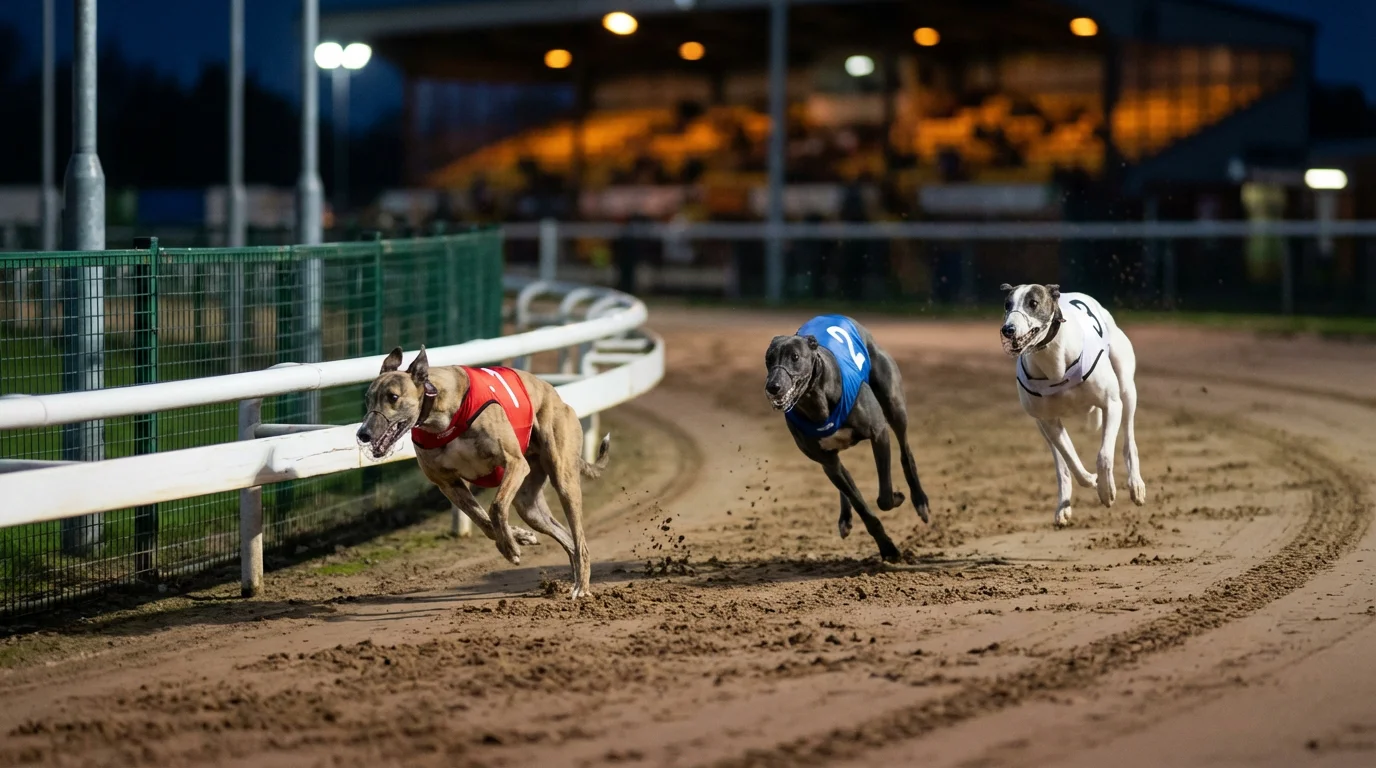
Greyhound form analysis is not guesswork dressed up in data — it is the data stripped of noise. Every racecard contains enough information to build a structured case for or against each runner. The problem is that most bettors either ignore the data and back gut feelings, or drown in the data and back nothing with conviction. Both approaches lose money. What works is a method: a repeatable process that filters the available information through a set of priorities and produces a selection you can justify with evidence.
This is not a tipping article. There are no hot dogs of the week here, no promised returns, no secrets. What you will find is a framework — five analytical pillars that, assessed in sequence, give you a clear picture of any greyhound race. The framework does not guarantee winners. It guarantees better questions, sharper assessments, and a decision-making process that improves with every race you apply it to.
The five pillars are trap draw, early pace, calculated time, grade context, and trainer form. Each one addresses a different dimension of a dog’s prospects, and each one interacts with the others. The method works not because any single pillar is revelatory, but because the combination forces you to evaluate comprehensively before you commit — rather than latching onto whatever stands out first and building a narrative around it.
The Five Pillars of Greyhound Form Analysis
Five factors. Assess them in order. Skip one and you are guessing. The sequence matters because each pillar builds on the one before it, narrowing the field from a general overview to a specific, evidence-based selection.
The first pillar is trap draw. Before you read a single line of form, you can assess whether each dog’s starting position suits its running style. A railer in trap 1 has a natural advantage. A wide runner in trap 6 has room to manoeuvre. A railer forced into trap 5 has a problem, and that problem exists independently of everything else on the card. Trap draw is the pre-filter: it tells you which dogs start with a structural edge and which dogs start with a structural handicap.
The second pillar is early pace. Once you know who is drawn where, the next question is who gets to the first bend in front. Early pace, measured by split times on the racecard, is the single strongest predictor of finishing position in greyhound racing. The leader at the first bend avoids crowding, secures the racing line, and forces every other runner to go around. If two dogs with similar split times are drawn next to each other, that is a crowding risk. If one dog’s split time is clearly superior to the rest, that is a pace advantage.
The third pillar is calculated time — the going-adjusted finishing time that allows fair comparison across different tracks and conditions. Raw winning times are unreliable because they depend on the surface condition on the night. Calculated time strips that variable away. A dog with consistently strong calculated times across its last four runs is performing to a measurable standard. A dog with wildly fluctuating calculated times is unreliable, regardless of whether it happened to win last time out.
The fourth pillar is grade context. What level has this dog been competing at, and how does that compare to tonight’s race? A dog moving down in grade should find tonight’s competition easier. A dog moving up faces tougher opponents. The grading system creates natural betting opportunities — dogs that are well suited to a particular level but temporarily misgraded by the racing manager. Recognising these mismatches is one of the most reliable edges available to form students.
The fifth pillar is trainer form. Certain trainers run their dogs into peak condition for specific targets. Others maintain a steady stream of runners without peaking them for particular events. Tracking which trainers are currently in form — winning at a rate above their baseline — adds a human dimension to what can otherwise feel like a purely statistical exercise. Dogs do not prepare themselves. Trainers do. And trainer intent can influence whether a dog arrives at a race ready to run to its best or simply filling a slot on the card.
Trap Draw Analysis
The trap draw is the only variable you can assess before you look at a single line of form. It is visible at a glance, and its implications are immediate. Every greyhound is assigned a running style designation by the racing manager: railer (R), middle runner (M), or wide runner (W). This designation reflects the dog’s natural preference for where it runs on the track, and the racing manager uses it to allocate trap positions. Railers go to the inside traps — 1 and 2. Wide runners get the outside — 5 and 6. Middle runners slot into 3 and 4.
The system works most of the time. When a railer draws trap 1, it has a clear path along the inside rail to the first bend. It does not need to cross traffic, does not need to adjust its line, and does not need to compete for space with dogs running a different pattern. That is the ideal scenario, and it produces a measurable win-rate advantage. Data from UK tracks consistently shows that trap 1 produces the highest percentage of winners across large samples, particularly at tight, inner-railed tracks where the distance advantage of the shortest route is most pronounced.
But the system is imperfect, and imperfections create betting opportunities. Sometimes the dog population at a track does not produce a clean match of style to trap. A railer might end up in trap 3 because traps 1 and 2 were allocated to other railers with higher priority. A wide runner might find itself in trap 4 because two other wide runners took the outside boxes. When a dog’s running style does not match its trap draw, you have a mismatch — and mismatches create trouble at the first bend.
Track geometry amplifies or dampens trap bias. At tracks with a short run from the traps to the first bend — Romford being the classic example — inside traps have an exaggerated advantage because there is less time for the field to sort itself out before the first turn. At tracks with a longer run-up, like Nottingham or Towcester, the field has more room to find natural positions before the bend, and the trap draw matters less. Knowing which tracks reward inside draws and which ones neutralise them is a significant analytical edge.
Cross-reference the trap draw with the dog’s recent form. Has it raced from this trap position before? How did it perform? A dog that has won from trap 1 in three of its last five starts is proven on the rail. A dog that has never raced from trap 6 is entering unknown territory. The racecard will show you the trap drawn in each recent run — use it. Trap draw is not a decisive factor in every race, but it is always a relevant one, and assessing it costs you nothing but thirty seconds of attention.
Early Pace and Split Time Strategy
The first two seconds of a greyhound race contain more predictive data than the next twenty-eight. That is not hyperbole. The split time — typically the time to the first bend, measured from trap opening — is the single most statistically significant variable in predicting the race winner. Dogs that lead at the first bend win at a rate far exceeding their implied probability from the odds. The reason is simple: the first bend is where trouble happens, and the dog in front avoids it.
In a standard four-bend race over 480 metres, the field converges on the first turn within roughly four seconds of the traps opening. Six dogs, running at close to 40 miles per hour, funnelling into a left-hand bend. The dog with the fastest split time reaches that bend first and takes the inside line. Every other dog must negotiate around it, which costs time, energy, and — if the field is bunched — physical interference. Crowding, checking, bumping: these events disproportionately affect mid-pack and rear runners. The leader simply runs.
When comparing split times across a six-dog field, look for clear separation. A gap of 0.10 seconds or more between the fastest splitter and the next dog is meaningful — it usually translates to at least a length of advantage at the first bend. If one dog splits 3.82 and the next fastest is 3.93, the leader will reach the bend comfortably clear and dictate the race from there. That is a strong structural advantage, and it should be weighted heavily in your assessment.
The danger zones emerge when two or three dogs have similar split times. If trap 2 splits 3.85, trap 3 splits 3.87, and trap 4 splits 3.86, the first bend is going to be contested. These three dogs will arrive at roughly the same time, from adjacent starting positions, and the probability of crowding is high. In these situations, the dog with the very best split time — even if the margin is tiny — has a slight edge, but the overall race becomes less predictable. Competitive early pace often favours a closer who can avoid the trouble and pick up the pieces on the back straight.
Do not treat split times as static. A dog’s split time varies from race to race depending on trapping, track condition, and the draw itself. Look at the average across the last three or four runs rather than the single best. A dog that consistently splits under 3.90 is a genuinely fast starter. A dog that managed 3.82 once but usually splits 3.98 is a moderate trapper that got lucky. The pattern matters more than the peak.
Calculated Time and Distance Preference
Time tells you speed. Calculated time tells you ability. The raw winning time of a race depends on track conditions — a fast track produces fast times, a slow track produces slow ones. If you compare two dogs based on their raw times from different nights, you are comparing apples to weather forecasts. Calculated time solves this by applying a going correction to the winning time, producing a standardised figure that reflects the dog’s performance independent of surface conditions.
When reviewing a racecard, the CalcTm column is where you find the dog’s true competitive level. A dog that has recorded calculated times of 29.50, 29.55, 29.48, and 29.53 over its last four runs is performing with remarkable consistency. You know, within a narrow band, what this dog is capable of. Compare that to a dog with calculated times of 29.40, 30.10, 29.65, and 29.90 — the range is wide, and you have no confident basis for predicting where it will land tonight. Consistency in calculated time is not glamorous, but it is one of the most reliable indicators of a dog you can trust to run to its level.
Distance preference is the other half of this pillar. Greyhounds, like human sprinters and distance runners, have optimal distances. A dog bred for speed may excel over 285 metres but struggle to sustain effort over 480. A dog with stamina in its bloodline may run flat over two bends but come alive over four. The racecard shows you the distances of recent runs. If a dog has been running well over 480 metres and is now entered over 285, treat it as an unknown quantity. The calculated times from its 480-metre races are not transferable to a sprint — the physical demands are fundamentally different.
Star times — marked with an asterisk on many racecards — denote a dog’s best recent calculated time. This figure sets the ceiling. The question to ask is not “can this dog run this fast?” but “how often does it run close to this time?” A dog whose star time is 29.40 but whose last four runs average 29.70 is not a 29.40 dog. It is a 29.70 dog that once ran significantly above itself. Bet on the average, not the exception. The exception was probably aided by a clear run, perfect conditions, or a race that fell apart for everyone else.
Grade Movement and Class Context
A dog dropping from A3 to A5 is not necessarily out of form — it might be exactly where the value is. The grading system in UK greyhound racing functions as an unofficial handicapping mechanism. Dogs that win move up in grade; dogs that lose consistently move down. The racing manager at each track administers this process, and while it follows general rules, there is discretion involved. Understanding that discretion — and the patterns it creates — is a significant analytical advantage.
Grade drops are where the most reliable value tends to hide. A dog that competed at A3 and recorded calculated times that were competitive at that level, but did not win often enough to stay there, gets moved down to A4 or A5. At the lower grade, it faces weaker opposition. Its calculated times, which were merely adequate at A3, may be superior to everything else in the A5 field. The market sometimes adjusts for this, but not always — particularly in races where the dog’s recent finishing positions (third, fourth, fifth at A3) look unimpressive on the surface. The positions masked the fact that the dog was running against better animals.
Grade rises present the opposite scenario and the opposite risk. A dog that has won two or three races at A5 gets promoted to A4 or A3. Its form looks excellent: recent wins, improving times, clean remarks. But the competition at A3 is materially stronger. The calculated times that dominated at A5 may be ordinary at A3. Backing a dog off the back of a winning streak without checking whether its times are competitive at the new grade is one of the most common mistakes in greyhound betting.
There is a subtler dynamic worth watching: dogs that are deliberately held in grade or moved laterally. A racing manager might keep a dog at A4 rather than promoting it to A3 because the A4 fields at that track are unusually weak, or because the dog’s running style suits the typical A4 race profile. These decisions are not random, and attentive punters who follow a specific track over weeks will notice when a dog seems favourably graded relative to its ability. That observation, combined with strong calculated times and a good draw, is the foundation of a high-confidence selection.
Trainer Form and Kennel Patterns
Some trainers peak their dogs for big races. Others run them into form. Knowing which is which is an edge. Greyhound training is not a standardised process. Each kennel has its own methods, its own rhythms, and its own approach to race preparation. Some trainers are aggressive campaigners, running their dogs twice a week to keep them sharp. Others space runs carefully, using trials between races to maintain fitness without the wear of competition. The racecard does not tell you the training philosophy directly, but it gives you clues if you know where to look.
Trainer form — the recent win rate of a specific trainer’s runners — is the most accessible indicator. If a trainer’s dogs have won five of their last twenty starts, that is a 25 percent strike rate, well above average. It suggests the kennel is in good shape: dogs are healthy, fit, and arriving at races ready to perform. If the same trainer’s dogs have won one of twenty, something is off — illness, injury, a run of bad draws, or simply a weaker string of dogs in the kennel at that moment. Trainer form data is available from most results services and form sites, and checking it takes seconds.
Kennel confidence signals are harder to read but more valuable. When a trainer enters a dog at a specific track and distance that it has not raced at before, that is a deliberate choice. When a trainer scratches a dog from one meeting and redirects it to another, that is a targeting decision. These moves suggest the trainer believes the dog has a better chance in the new race — a softer grade, a more suitable distance, a track where the dog’s running style is rewarded. Following these movements requires attention to the card across multiple meetings, not just the one you are betting on, but the signal quality is high.
Trial runs — unofficial timed runs between meetings — are another piece of the puzzle. A dog that has had a trial since its last race may arrive sharper than one that has simply been resting. Some racecard providers note recent trials in the dog’s form block. A fast trial time, particularly one that is close to or better than the dog’s recent race times, is a strong positive indicator. It means the trainer is actively preparing the dog and the dog is responding.
Putting It All Together: A Race Assessment Walkthrough
Let us walk through a hypothetical six-dog race and apply every tool in the box. The race is a graded A4 over 480 metres at a standard four-bend track. Here is the field, simplified to the data that matters.
Trap 1: Railer, split time 3.84, CalcTm 29.55, last three finishes 1-2-1 at A5, moved up to A4. Trap 2: Middle runner, split 3.92, CalcTm 29.60, last three finishes 3-4-2 at A4, same grade. Trap 3: Railer, split 3.86, CalcTm 29.50, last three finishes 2-1-3 at A3, dropped to A4. Trap 4: Wide runner, split 3.95, CalcTm 29.70, last three finishes 5-3-4 at A4, same grade. Trap 5: Middle runner, split 3.90, CalcTm 29.65, last three finishes 1-5-2 at A4, same grade. Trap 6: Wide runner, split 3.88, CalcTm 29.45, last three finishes 4-6-1 at A3, dropped to A4.
Start with trap draw. Trap 1 is a railer in the rail box — ideal. Trap 3 is a railer in a middle box — less than ideal; it will need to cut across to the rail and may collide with Trap 2. Trap 6 is a wide runner in the outside box — natural position, no issues. So the draw favours Trap 1 and Trap 6 from a running-style perspective.
Next, early pace. Trap 1 has the fastest split at 3.84. Trap 3 is close at 3.86. These two are drawn two boxes apart with Trap 2 (a slower trapper at 3.92) between them. Trap 1 should lead into the first bend with Trap 3 trying to cross from the middle. There is crowding risk for Trap 3, but Trap 1 should come out clean. Trap 6 splits 3.88, which is decent, but from the outside it has more ground to cover into the first bend.
Calculated time. Trap 6 has the best CalcTm at 29.45, but its recent form is erratic: 4-6-1. That inconsistency is a red flag — it can run fast but does not do so reliably. Trap 3 at 29.50 is more consistent (2-1-3 at a higher grade). Trap 1 at 29.55 is slightly slower but has been winning at A5 and is stepping up. Grade context confirms: Trap 3 and Trap 6 are both dropping from A3, where their times were competitive. Trap 1 is rising from A5, where its times were dominant but may be merely adequate at A4.
The assessment narrows. Trap 3 has the strongest combination: second-fastest split, best consistent CalcTm, dropping in grade, and proven at a higher level. The main concern is the draw — a railer in trap 3 who needs to find the rail. Trap 1 has the best draw and the fastest split but is stepping up in class for the first time. Trap 6 has the best single CalcTm but unreliable form.
The selection depends on your confidence weighting. If you prioritise draw and early pace, Trap 1 is the pick — it leads, it rails, and it only needs to prove it can compete at A4. If you prioritise class and calculated time, Trap 3 is the pick despite the awkward draw. A reasonable punter could back either. A forecast covering both — Trap 1 and Trap 3 in either order — would be the natural bet type for someone who cannot separate them. That is the framework in action: not a guaranteed answer, but a structured way to reach one.
The Edge Is Cumulative, Not Instant
One race will not prove your method. Fifty races will. Form analysis is a discipline with a long feedback loop. You will apply the five pillars to a race, make a selection, watch it finish fourth, and wonder whether the framework works at all. It does. But not on any single race — on the aggregate. Over fifty races, a hundred races, a season of regular betting, a structured approach to form analysis produces a measurably higher strike rate and a better return on investment than unstructured instinct.
The edge is cumulative because it compounds. Every race you analyse sharpens your ability to read the next one. You start noticing patterns in trap draw data that you missed before. You develop an intuitive sense for which calculated times are competitive at a given grade. You learn which trainers target specific meetings and which ones spread their entries thin. None of these skills arrive in a single session. They build gradually, and they build only if you apply the method consistently rather than abandoning it after a losing night.
Greyhound racing produces thousands of races a year across twenty-plus licensed tracks. The data is abundant. The markets reset every fifteen minutes at a busy meeting. Every reset is a new test of your analytical framework. Embrace the frequency. Use it to practise, to refine, and to develop the kind of pattern recognition that turns a set of principles into a genuine, sustainable edge. The method is here. The application is yours.
Find more strategy guides at centralparkdogresult.
Also read our greyhound betting mistakes.
