
What Is Greyhound Racing? A Beginner's Guide to the Sport
 Available in US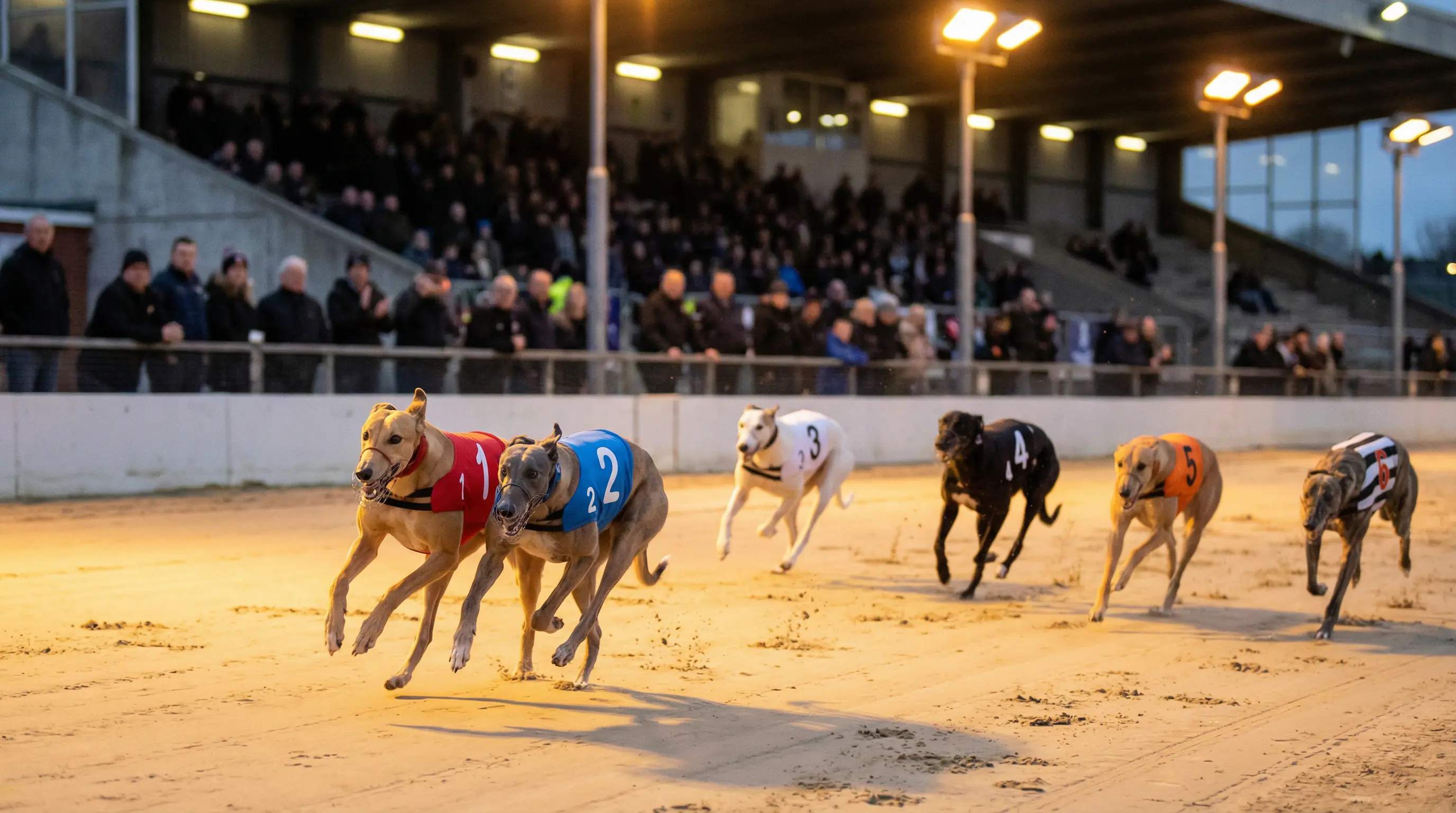
Greyhound racing is the second-largest spectator sport in Britain that most people have never actually watched. While football dominates the headlines and horse racing gets the royal treatment, greyhound racing has been quietly filling stadiums, generating betting turnover, and producing some of the most data-rich sporting events in the country since 1926.
The premise is simple enough to explain in a sentence: six dogs chase a mechanical hare around a sand track, and the first one across the line wins. A race lasts about thirty seconds. An entire evening card of twelve races wraps up in under three hours. For bettors, that frequency is the appeal. Where horse racing might offer eight races spread across an afternoon, a single greyhound meeting delivers more opportunities in less time, with markets that move fast and form data that rewards anyone willing to read it.
This guide covers the fundamentals. How a race is structured, who regulates the sport, how it compares to horse racing, and why it continues to thrive in an era when plenty of people assumed it would disappear. If you’re new to greyhound racing, this is the starting line.
How a Greyhound Race Works
The traps open. Six dogs explode forward. Thirty seconds later, it’s over. That compressed timeframe is what makes greyhound racing both thrilling and deceptively complex. A lot happens in half a minute, and understanding the sequence helps you appreciate why form analysis matters as much as it does.
Before a race begins, each dog is weighed and checked by the track’s resident veterinary surgeon. This isn’t ceremonial. The weigh-in confirms the dog is within its expected racing weight, and any significant deviation gets flagged. Dogs that arrive too heavy or too light can be withdrawn. After the vet check, the dogs are paraded in front of the crowd wearing numbered jackets in specific colours: red for trap one, blue for trap two, white for three, black for four, orange for five, and striped black-and-white for trap six. These colours are standardised across every licensed track in the UK.
Once paraded, the dogs are loaded into starting traps by the kennel staff. The mechanical hare — mounted on a rail that runs along the inside of the track — begins its circuit. When it passes the traps at the right speed and distance, the lids spring open simultaneously and the dogs break. The start is crucial. In sprint races of 250 to 300 metres, a dog that’s slow out of the traps may never recover. In longer races, early pace still matters, but there’s more track to make up ground.
As the field enters the first bend, positions crystallise. The dog that leads at the first bend wins more often than any other single variable would predict. Crowding, bumping, and checking — where a dog loses momentum because another cuts across its path — all tend to happen at the bends, particularly the first and second. The finishing straight is where late runners make their bid, but the race is often decided long before that point.
At the line, a photo-finish camera captures the result. Judges confirm the finishing order, the distances between each dog are recorded in lengths, necks, and heads, and the official result is declared. Winning time, sectional splits, and finishing distances are all logged. Each race produces a dense packet of data — and for bettors, every number in that packet is usable.
The Role of the GBGB
The Greyhound Board of Great Britain regulates every licensed track in the country. If a stadium holds a GBGB licence, its races must comply with a standardised set of rules covering everything from drug testing to track maintenance, grading systems to welfare protocols. The GBGB doesn’t run the tracks — it oversees them.
That oversight has practical consequences for bettors. GBGB-licensed meetings carry official results, verified form data, and regulated grading. When you look at a racecard from a licensed track, the grade assigned to a race (A1 through D4, with open races at the top) reflects the GBGB’s framework. Dogs are tested for prohibited substances, and racing managers operate under published guidelines for how they assign traps and move dogs between grades. None of that applies at independent, unlicensed tracks — often called “flapping” tracks — where regulation is looser and data reliability drops accordingly.
The GBGB also manages the Greyhound Retirement Scheme and welfare standards, which have become increasingly prominent in recent years. Welfare audits, injury reporting, and post-racing rehoming are all part of the board’s remit. For the betting public, the practical takeaway is straightforward: licensed meetings are the ones where form data can be trusted, results are officially recorded, and the competitive integrity of the sport has a governing framework behind it. There are currently around twenty GBGB-licensed stadiums operating in England, Scotland, and Wales, though that number has fluctuated over the decades as tracks close and new licences are occasionally issued. The licensed circuit forms the backbone of everything covered in serious greyhound analysis.
Greyhound Racing vs Horse Racing
Fewer runners, faster results, and a form card that actually fits in your pocket. Greyhound racing and horse racing share a betting culture, but the two sports operate on fundamentally different rhythms, and understanding those differences shapes how you approach each one.
Field size is the most obvious distinction. A greyhound race has six runners. A horse race can have anywhere from four to forty. Smaller fields mean fewer variables, which sounds like it should make greyhound racing easier to predict. In some ways, it does — the mathematical probability of picking the winner from six is inherently higher than picking one from sixteen. But smaller fields also mean tighter margins. The difference between the favourite and the third pick in a six-dog race is often measured in fractions of a second. Tight margins make form reading essential, not optional.
Race frequency is the other major difference. A single greyhound meeting typically features ten to twelve races, and many tracks run four or five meetings per week. In a given week, the UK greyhound schedule produces hundreds of races. Horse racing, by comparison, runs fewer meetings with fewer races per card. For bettors, this changes the strategic calculus. Greyhound racing offers more chances to find value, but also more chances to overextend. Bankroll discipline matters more when the next race is eight minutes away, not eight days.
From a cost perspective, attending a greyhound meeting is significantly cheaper than a day at the races. Entry fees are low or nonexistent at many tracks, food and drink prices are closer to a local pub than a hospitality tent, and the atmosphere is more working club than garden party. That accessibility has always been part of the sport’s identity. Greyhound racing doesn’t pretend to be exclusive. It never has.
The betting markets differ in depth too. Horse racing has well-established ante-post markets weeks or months before major events. Greyhound ante-post markets exist for the big competitions — the English Greyhound Derby, the St Leger, the Oaks — but the day-to-day betting is much more immediate. Prices appear on the racecard, move in the minutes before the off, and settle at SP. It’s a faster cycle, and it suits bettors who prefer to react to information rather than speculate on it.
Why Greyhound Racing Hasn’t Gone Anywhere
Reports of greyhound racing’s death have been exaggerated for decades. The sport has lost tracks — some of them iconic — to property development and shifting demographics. Wimbledon, one of London’s most famous venues, closed in 2017. Others have followed. Each closure generates the same headlines about the sport’s decline, and each time the sport absorbs the loss and continues.
What keeps greyhound racing viable is a combination of media rights revenue, betting turnover, and structural consolidation. Arena Racing Company, which owns and operates several major tracks including Central Park in Sittingbourne, has professionalised the business side. Media deals with SIS (Sports Information Services) and partnerships with betting operators like Entain mean that greyhound races are broadcast live to betting shops and online platforms across the country. You don’t need to be at the track to watch a race. You don’t even need to be awake at a conventional hour — morning meetings from tracks like Central Park are specifically scheduled to serve the betting market.
Digital streaming has expanded the audience further. Most major bookmakers offer live streaming of greyhound races to customers with funded accounts, and some require only a small qualifying bet to unlock the feed. That accessibility has brought a new generation of bettors to the sport, many of whom have never set foot in a stadium. They engage through data, form cards, and live video — and the sport’s data infrastructure has adapted to serve them.
The betting volume reflects this resilience. Greyhound racing remains one of the most bet-on sports in the UK, behind only football and horse racing. The Betting and Gaming Council’s industry reports consistently show greyhound racing generating significant gross gambling yield, driven partly by the sheer volume of races available every week. For the industry, that volume is the product. For the bettor, it’s the opportunity.
Six Traps, One Hare, and a Whole Lot of Data
Every race is a 30-second dataset — and the sport produces thousands of them a year. That’s the quiet advantage of greyhound racing for anyone who likes to work with information. The simplicity of the event (six dogs, one track, one result) creates a clarity that more complex sports struggle to match. There are fewer confounding variables, fewer unknowns, and more structured data per event than almost any other sport you can bet on.
A single greyhound race generates trap draws, split times, finishing distances, bend positions, going corrections, calculated times, race remarks, and trainer records. Multiply that by twelve races per meeting, five meetings per week at a busy track, and twenty licensed stadiums across the country, and the data pile grows fast. For the casual spectator, none of that matters — the race is entertaining enough on its own terms. For the bettor, it’s the raw material.
The sport rewards literacy. Not the kind you learn in a classroom, but the ability to read a racecard and see a story where someone else sees a grid of numbers. That literacy takes time to build. No guide — this one included — will make you fluent overnight. But every racecard you read, every result you compare to your expectation, and every bet you assess afterwards builds a layer of understanding that compounds over time. Greyhound racing is one of those rare sports where paying attention is itself an edge. The data is all there, published and available. The question is whether you bother to read it.
Find more racing guides at centralparkdogresult.
Also read our UK greyhound racing history.
