
Weather and Track Conditions in Greyhound Racing Explained
 Available in US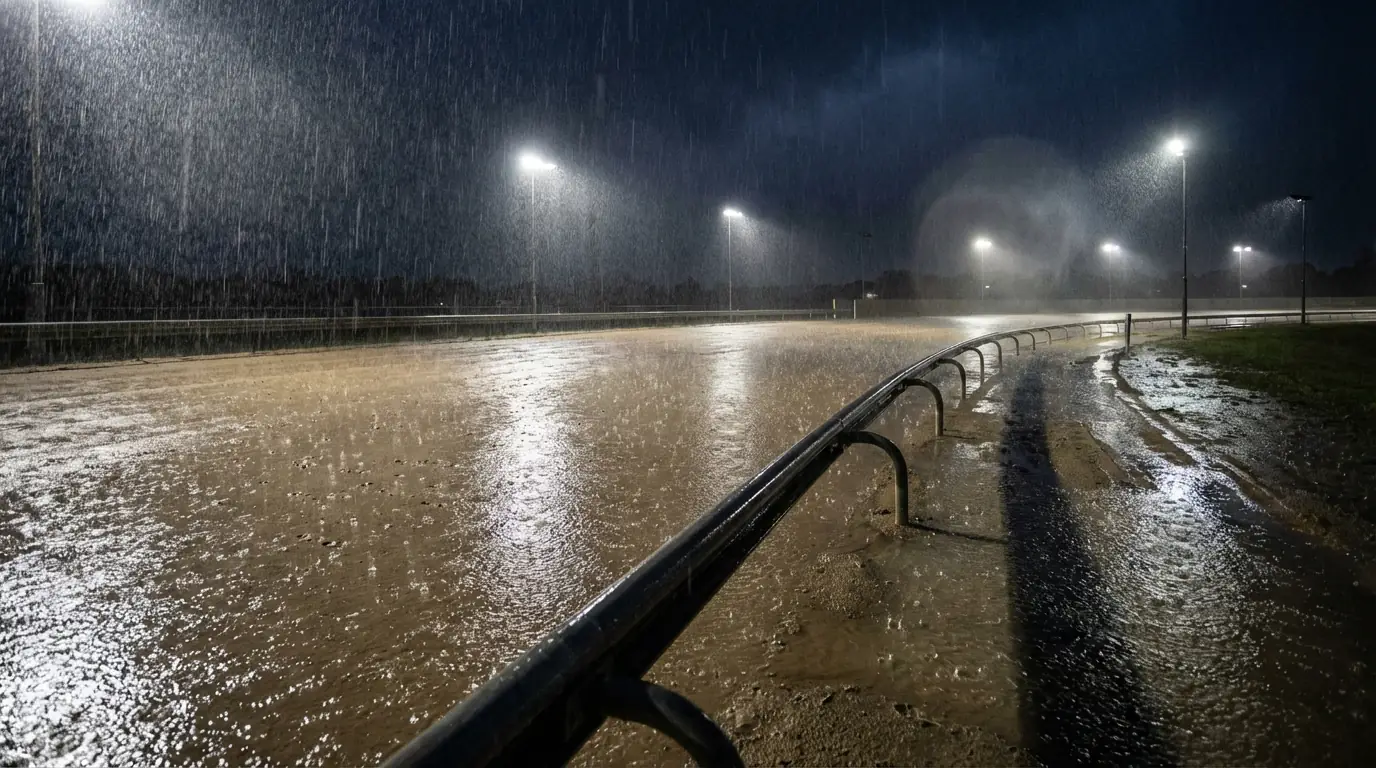
Rain starts falling an hour before the first race, and by the time the traps open, the sand is heavy. Splits are slower. Finishing times are longer. And the dog that’s been winning on fast going for the past month suddenly looks ordinary. Nothing about the dog changed. The track changed. For bettors who don’t account for weather and surface conditions, that distinction is invisible — and invisibility costs money.
Track conditions are one of the most tangible external variables in greyhound racing. They affect every dog in every race on the card, and they affect some dogs more than others. Rain, heat, frost, and surface maintenance all alter the character of the racing surface, which in turn alters the race times, the going correction, and the competitive balance between dogs with different physical profiles. This article covers how weather impacts the track, how the going is assessed and adjusted, and how to factor conditions into your betting decisions rather than ignoring them and wondering why the form didn’t hold up.
Sand, Rain and the Going
Every licensed UK greyhound track uses a sand-based racing surface (Owlerton Stadium), and the condition of that surface varies with moisture content. Dry sand is firm and fast — dogs grip well, stride efficiency is high, and finishing times are at their quickest. Wet sand is heavy and slow — each stride takes more effort, dogs tire faster over distance, and finishing times extend by measurable amounts. The difference between a dry track and a sodden one can add several tenths of a second to a standard-distance finishing time, which is enough to reshape the competitive order of a race.
The going — the official assessment of the surface condition — is determined by the track’s timekeeper before racing begins and is expressed as a going allowance: a positive number for slow going, a negative number for fast going, and zero or “normal” for standard conditions. This allowance is applied to finishing times to produce the calculated time that appears in form guides, stripping out the surface effect and allowing fairer comparison across meetings run under different conditions (Timeform).
Rain during a meeting can change the going between races on the same card. A meeting that starts on normal going may deteriorate to slow going by the later races if heavy rain persists. Tracks monitor conditions and can update the going allowance mid-meeting, though not all do so consistently. For bettors, this means that form figures from the early races on a rain-affected card may not carry the same going allowance as figures from the later races — a detail that matters when you’re comparing runs from different races on the same night.
Track maintenance also plays a role. Tracks are watered, rolled, and harrowed between meetings, and the quality of that maintenance affects the surface’s consistency (GBGB Track Liaison). A well-maintained track produces more predictable going conditions. A track that’s been inconsistently maintained can produce patchier surfaces where the going varies across different parts of the circuit — faster on one bend, slower on another. These variations are harder to measure but they exist, and experienced racegoers at specific venues learn to recognise them over time.
Heat and Welfare Cancellations
Extreme heat is one of the few weather conditions that can shut down a meeting entirely. The GBGB enforces welfare protocols that restrict or prohibit racing when temperatures exceed specific thresholds (GBGB Hot Weather Policy). These thresholds are designed to protect the dogs from heat-related illness, which greyhounds are particularly susceptible to because of their lean physiology, low body fat, and the intense physical effort of sprinting at maximum speed.
When a forecast predicts temperatures above the GBGB’s cutoff, meetings can be abandoned before racing begins or suspended mid-card if conditions deteriorate. For bettors, this means that summer scheduling carries cancellation risk — particularly for afternoon meetings at tracks in the south of England, where peak temperatures are highest. Bets placed on meetings that are subsequently abandoned are typically voided and stakes returned, but any disruption to your planned betting activity is worth anticipating.
Heat that falls below the cancellation threshold but is still elevated can affect race dynamics without triggering an abandonment. Dogs may tire more quickly, particularly in stayers’ events and races on the later part of the card. Surface conditions can change as heat dries out the sand, shifting the going towards the fast end of the scale during the meeting. These mid-meeting shifts are less dramatic than rain effects but still relevant for bettors tracking conditions across a multi-race card.
Frost and freezing temperatures present the opposite problem. A frozen surface is unraceable — dangerous for the dogs and structurally damaging to the track (GBGB Cold Weather Policy). Winter meetings at tracks in northern England and Scotland are particularly vulnerable to frost-related abandonment, and early morning inspections are common during cold spells. Again, bets on abandoned meetings are voided, but the frequency of winter cancellations at exposed venues is worth noting if you plan your betting around the seasonal calendar.
Dogs That Prefer Wet or Dry Conditions
Not all dogs handle all conditions equally. This isn’t intuition — it’s observable in the form data. Some dogs consistently produce their best calculated times and their best finishing positions on heavy going. Others perform measurably better when the track is dry and fast. The preference exists because the physical demands of running on different surfaces favour different body types and running styles.
Dogs with powerful builds and strong muscle mass tend to cope better with heavy going. The extra effort required to drive through wet sand suits dogs with natural strength and a grinding running style. These dogs may not be the fastest on a dry track, where lighter, more aerodynamic runners have an advantage, but on a heavy surface their power becomes a relative asset. If you notice a dog’s form improving consistently on slow-going nights and declining on fast-going nights, you’re seeing a condition preference in action.
Front-runners can be particularly affected by heavy going, because maintaining a lead requires sustained effort that a heavy surface amplifies. A dog that leads comfortably on fast going may fade earlier on slow going, because the energy cost of leading is higher. Closers, who sit behind the pace and finish late, can benefit when the going takes the edge off front-runners — picking up ground in the closing stages as the leaders tire from the additional surface resistance.
Identifying condition preferences requires looking at form data across multiple meetings under varying going conditions. Compare a dog’s CalcTm and finishing positions from its slow-going runs with its fast-going runs. If there’s a consistent pattern — faster CalcTm relative to the field on one type of going, slower on another — you’ve found a preference that can be used as a selection filter. On nights where the going is notably slow or notably fast, filtering for dogs whose form profile matches the conditions gives you a data-driven angle that pure speed figures miss.
Adjusting Your Bets for Weather
The practical application of weather awareness starts before the meeting begins. Check the going allowance when it’s published — it’s available on the racecard and through form providers. If the going is notably different from normal — significantly slow after heavy rain, or unusually fast after a dry spell — ask which dogs in each race are most likely to benefit or suffer from those conditions.
Cross-reference the going with each dog’s recent form. A dog whose last three runs were all on fast going is an unknown quantity if tonight’s going is heavy. Its CalcTm figures, while adjusted for going, may not fully capture how the dog physically handles a different surface. Conversely, a dog whose form includes runs under conditions similar to tonight’s going is a more predictable proposition — you have directly relevant data rather than extrapolated estimates.
Weather changes during a meeting are harder to account for but still worth monitoring. If rain starts falling mid-card, the later races will be run on heavier going than the earlier ones. Dogs entered in the later races that prefer wet conditions become relatively more attractive. Dogs that need fast going become relatively weaker selections. Watching the weather and adjusting your assessments in real time — rather than sticking rigidly to pre-meeting analysis — is a mark of a bettor who understands that greyhound racing is an outdoor sport played on a natural surface, not a standardised laboratory experiment.
Some bettors take conditions a step further and maintain track-specific going records — noting the going allowance at each meeting they follow, tracking which dogs perform above or below expectation under which conditions, and building a personal database that supplements the public form data. That level of detail isn’t necessary for casual bettors, but for anyone who bets regularly at specific tracks, it’s an investment that compounds over time.
You Can’t Control the Weather — But You Can Read It
Weather is the one variable in greyhound racing that nobody can influence. Trainers can manage fitness. Racing managers can allocate traps. Bettors can analyse form. But when it rains, it rains — and the track changes for everyone. The bettors who treat weather as background noise, betting the same way regardless of conditions, are giving up an edge to those who treat it as data.
The going allowance is published. The weather forecast is available to everyone. The form data under different conditions is sitting in the racecard for anyone willing to look through a dog’s recent runs and note the going for each one. None of this is hidden information. It’s public, it’s free, and it’s underused by a surprising proportion of the betting market. On a wet night, the bettor who knows which dogs handle the heavy and which ones don’t has an advantage. On a dry night, the same principle applies in reverse. The weather can’t be controlled. The response to it can.
Get more race analysis at centralparkdogresult.
Also read our going allowance and calculated time.
