Greyhound Racing History in the UK: From 1926 to Today
Best Greyhound Betting Sites – Bet on Greyhounds in 2026
Loading...
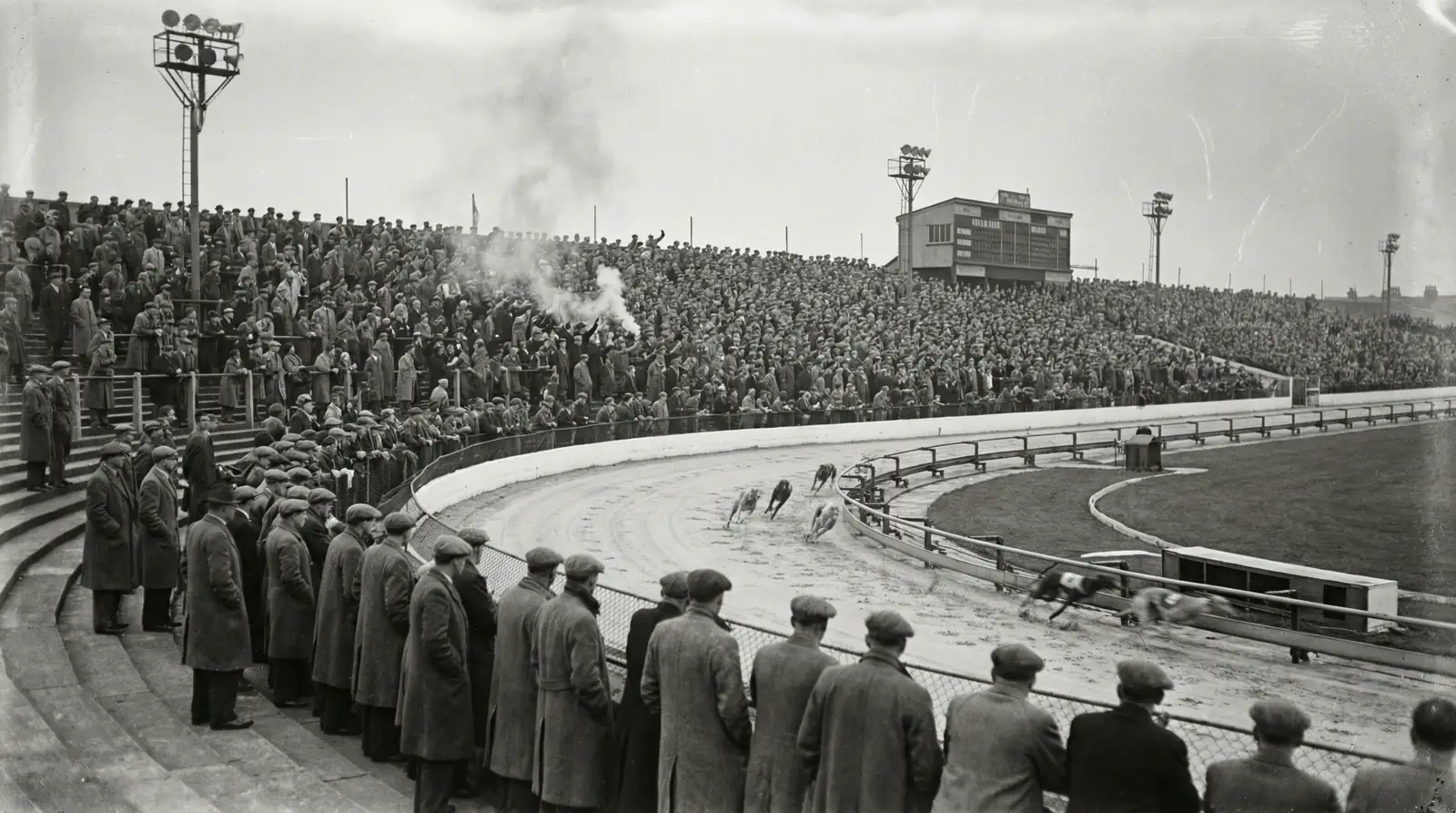
Greyhound racing in Britain is nearly a century old — born in the industrial north, raised on the terraces of working-class stadiums, and reshaped by every major shift in British leisure, regulation, and technology since the 1920s. Its story is one of extraordinary popularity, prolonged decline, and a modern reinvention that has kept the sport alive in a form its founders wouldn’t recognise but probably wouldn’t object to.
Understanding the history of greyhound racing isn’t just cultural tourism. The sport’s structure today — its grading system, its track network, its relationship with bookmakers and broadcasters — is the product of decisions and pressures that accumulated over decades. Knowing where the sport came from helps explain why it works the way it does now, and why some of its quirks make more sense as inherited features than as deliberate design choices.
Belle Vue 1926: Where It All Started
The first regulated greyhound meeting in Britain took place at Belle Vue Stadium in Manchester on 24 July 1926. The event was organised by an American businessman, Charles Munn, and a British promoter, Major Lyne-Dixon, who had seen oval-track greyhound racing succeed in the United States and believed the format would translate to a British audience. They were right. The opening night at Belle Vue attracted around 1,700 spectators (gbgb.org.uk). Within weeks, the crowds had swelled into the thousands.
The timing was deliberate. Belle Vue offered something that horse racing, the established betting sport, did not: evening entertainment accessible to working people who couldn’t take afternoons off to attend racecourses. The meetings ran under floodlights — themselves a novelty — in purpose-built or adapted stadiums located in or near urban centres. You didn’t need a car, a day off, or a special trip to the countryside. You needed a bus fare and an evening free.
The format spread rapidly. Within a year of Belle Vue’s opening, new greyhound tracks opened across England and Scotland — White City in London, Perry Barr in Birmingham, Powderhall in Edinburgh. By the end of the 1920s, there were more than sixty licensed tracks operating in Britain. The sport had gone from an untested import to a national entertainment phenomenon in the space of three years, driven by a combination of accessible locations, evening scheduling, and the appeal of a fast, simple betting product that required no specialist knowledge to enjoy.
The Golden Age of Greyhound Racing
The 1930s through the 1960s were the peak of greyhound racing as a mass spectator sport. Annual attendance figures in 1946 reached an estimated seventy million admissions (greyhoundracinguk.com) — a figure that made greyhound racing, by some measures, the most attended sport in Britain. White City Stadium in London alone could hold over ninety thousand spectators, and major events drew crowds that rivalled those of top-flight football.
The popularity was rooted in social function as much as sporting appeal. Greyhound stadiums were community venues — places where people from the surrounding neighbourhoods came for an evening out that combined entertainment, socialising, and the possibility of a winning bet. The restaurants, bars, and tote halls that surrounded the tracks were as much a part of the experience as the racing itself. For many working-class Britons, “going to the dogs” was a regular social fixture, not an occasional outing.
The betting economy was the engine that sustained the sport’s infrastructure. On-course tote pools generated revenue that funded prize money, track maintenance, and stadium improvements. The relationship between the tracks and the betting public was direct and mutually dependent: spectators came to bet, and the revenue from their bets kept the tracks running. That economic model worked brilliantly as long as the stadiums were full — and for decades, they were.
The sport also produced genuine stars during this period. Mick the Miller, a brindle dog who won two consecutive English Greyhound Derbys in 1929 and 1930 (gbgb.org.uk), became one of the most famous animals in Britain — the subject of newsreels, newspaper features, and public appearances. His fame transcended the sport and brought greyhound racing to an audience that might never have visited a stadium. Later decades produced their own champions — Ballyregan Bob, Scurlogue Champ, Westmead Hawk — each of whom captured public attention and demonstrated the elite athletic ability of the racing greyhound.
Decline and Consolidation
The decline of British greyhound racing as a mass spectator sport began in the 1960s and accelerated through the following decades. The causes were multiple and reinforcing: television gave people evening entertainment at home, the lifting of betting shop restrictions in 1961 allowed off-course betting that didn’t require a trip to the stadium, changing demographics shifted leisure patterns, and the urban land that greyhound stadiums occupied became vastly more valuable for property development than for racing.
Track closures became a defining feature of the sport’s later twentieth century. White City closed in 1984. Hackney in 1997. Wimbledon — the last London track — held on until 2017, when the site was sold for redevelopment as a new football stadium for AFC Wimbledon (skysports.com). Across the country, dozens of tracks closed permanently, their land converted to supermarkets, housing estates, and retail parks. Each closure reduced the sport’s physical footprint and the number of venues available for racing and breeding.
The tracks that survived consolidated under corporate ownership. Arena Racing Company (ARC) became the dominant operator, acquiring multiple tracks and centralising their management. This consolidation brought efficiencies — shared broadcast infrastructure, coordinated fixture scheduling, standardised grading — but it also changed the character of individual tracks, which had historically been independent operations with distinct local identities. The consolidated model prioritised commercial viability: broadcast-friendly meeting schedules, SIS-compatible race timing, and betting-revenue-driven fixture lists.
Through this period, the total number of licensed tracks shrank from over sixty at the sport’s peak to around twenty in the modern era (gbgb.org.uk). The sport didn’t die. It contracted — shedding the casual spectator base that had sustained the Golden Age and retaining a smaller but committed core of trainers, owners, bettors, and racegoers who valued the sport enough to keep it running even as the venues around it disappeared.
Modern Greyhound Racing: The Digital Era
The modern greyhound racing industry looks almost nothing like its mid-century predecessor in terms of how the product reaches its audience. Stadium attendance is a fraction of its historical peak, but betting turnover has been sustained — and in some periods increased — by the migration to online and off-course betting channels. The dogs still race around an oval track. The audience watches on screens rather than from the stands.
SIS broadcasts and media rights deals have turned greyhound racing into a continuous content product. Tracks schedule morning, afternoon, and evening meetings to fill the broadcast calendar, producing live racing content from early morning to late evening, seven days a week. This content feeds into bookmaker platforms, betting shops, and streaming services, reaching an audience that is overwhelmingly remote rather than present at the track. The economics have shifted accordingly: the revenue that matters most is no longer gate money and on-course tote pools but media rights fees and off-course betting levies.
The GBGB’s regulatory framework has modernised alongside the commercial model. Welfare standards have been codified and enforced more rigorously than in previous decades, with injury reporting, retirement rehoming, and kennel inspections forming part of the licensing regime. The sport’s public image, once battered by welfare concerns and a perception of seediness, has been actively managed through transparency initiatives and charity partnerships that aim to demonstrate the industry’s commitment to the dogs’ wellbeing throughout and after their racing careers.
Data has transformed the betting side. Racecards, form guides, and results are available instantly through online platforms. Split times, calculated times, going corrections, and historical statistics are accessible to anyone willing to look for them. The analytical depth available to a modern greyhound bettor is orders of magnitude greater than what was available to a stadium punter in the 1970s, and that data richness has attracted a generation of bettors who approach the sport as a quantitative exercise rather than a night out.
A Hundred Years On, the Hare Still Runs
Greyhound racing in Britain is approaching its centenary with a footprint that is smaller, a profile that is lower, and an operating model that is fundamentally different from the one that filled Belle Vue in 1926. The packed terraces are gone. The community-venue stadium culture has faded. The celebrity greyhounds that once made national headlines have been replaced by dogs whose names are known only to the people who follow the form guides.
But the core of the sport — six dogs, one hare, a thirty-second race that produces a result determined by speed, stamina, and the chaos of the first bend — is unchanged. The lure runs. The traps open. The dogs chase. And in stadiums from Nottingham to Sunderland, from Romford to Kinsley, the races continue because a community of trainers, owners, bettors, and racegoers values the sport enough to sustain it. A hundred years on, that community is smaller but no less committed. The hare still runs because the people behind the sport still care.