
Place and Each-Way Bets in Greyhound Racing Explained
 Available in US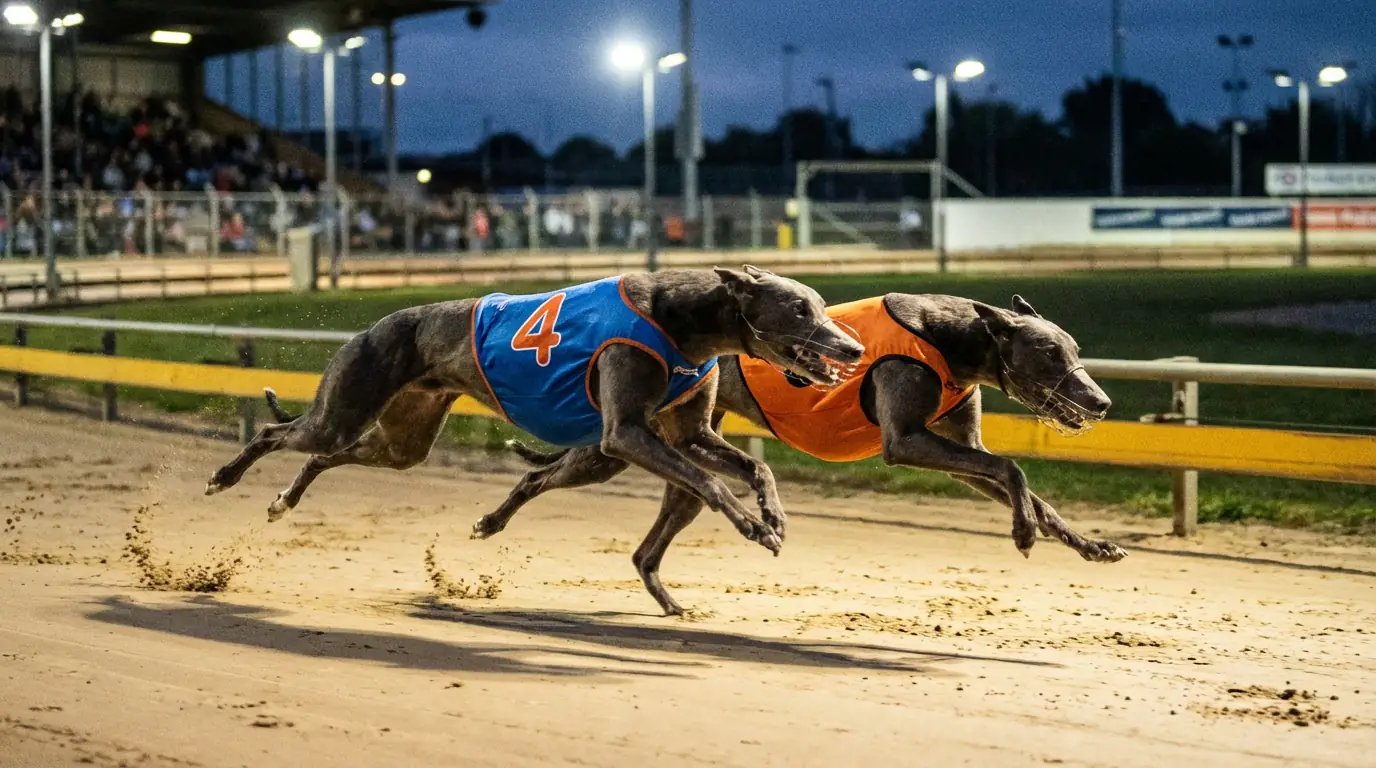
Not every selection needs to win to return a profit. That’s the premise behind place bets and each-way bets — two market types that give you a payout if your dog finishes in the top positions rather than exclusively in first. For bettors who see value in a dog but aren’t confident enough to commit entirely to the win, these bets offer a structured way to reduce risk while maintaining exposure to the race.
The trade-off, of course, is return. A place bet pays less than a win bet. An each-way bet doubles your stake. Neither is free money, and both involve calculations that many bettors get wrong or ignore entirely. This article breaks down how place and each-way bets work in greyhound racing’s standard six-runner fields, walks through a full payout example, and explains when each option genuinely adds value versus when it quietly erodes your bankroll.
How Place Bets Work in 6-Runner Fields
A place bet backs a dog to finish in the top two positions. In greyhound racing, where the standard field is six runners, the place terms are fixed: first or second. This is tighter than horse racing, where place terms vary with field size and can extend to third or even fourth. With greyhounds, there’s no ambiguity. Top two or nothing.
The place-only bet is distinct from an each-way bet. When you place a bet “to place,” your entire stake rides on the dog finishing first or second. The payout is calculated at a fraction of the win odds — in greyhound racing, the standard fraction is one quarter of the odds. So if a dog is priced at 8/1 for the win, the place odds are 2/1 (a quarter of 8/1). A ten-pound place bet on that dog returns thirty pounds if it finishes first or second: twenty pounds profit at 2/1 plus your ten-pound stake.
Place-only bets are less commonly used than each-way bets in greyhound racing, but they have a specific tactical role. If you believe a dog will finish in the top two but aren’t confident it can win, a place bet lets you back that assessment without the additional cost of the win portion that an each-way bet entails. It’s a purer expression of a “top two” opinion.
The limitation is the compressed payout. At a quarter of the win odds, the returns are modest unless the dog is at a long price. A place bet on a 2/1 shot pays at 1/2 — which means risking ten pounds to profit five. At that level, the risk-reward ratio starts to look unattractive unless your confidence in a top-two finish is very high. Place-only bets work best at longer odds, where the fractional place price still offers a meaningful return. At short prices, the maths rarely justifies the bet.
Each-Way Mechanics: Two Bets in One Stake
An each-way bet is two bets in one: a win bet and a place bet, combined at equal stakes. This is the detail that catches out many beginners. When you place a ten-pound each-way bet, your total outlay is twenty pounds — ten on the win and ten on the place. The slip says ten pounds each-way; your account is debited twenty. That doubling of the stake is fundamental to understanding whether each-way betting makes financial sense in any given situation.
If the dog wins, both parts of the bet pay out. The win portion pays at the full odds, and the place portion pays at a quarter of the odds. You collect on both. If the dog finishes second, only the place portion pays out. The win portion is lost. And if the dog finishes third or worse, both portions lose. There’s no partial consolation for a third-place finish in a six-runner greyhound race.
The each-way fraction in greyhound racing is standardised at one quarter of the win odds for the top two places. Some bookmakers occasionally offer enhanced each-way terms as promotions — extra places or improved fractions — but the default terms are one quarter, top two. It’s worth checking before placing the bet, because the fraction directly affects the place return and, by extension, whether the bet is good value.
The mental trap with each-way betting is that it feels safer than win-only. And it is safer, in the sense that you have two routes to a return instead of one. But that safety costs money — literally double the stake. A bettor who routinely places each-way bets without considering whether the extra cost is justified is paying for insurance on every race, whether the insurance is needed or not. Sometimes it is. Often it isn’t. The question is always whether the probability of finishing second (but not first) is high enough to justify the additional outlay.
Worked Each-Way Payout Example
Numbers make this concrete. Take a dog priced at 6/1 in a standard six-runner race. You place a ten-pound each-way bet, meaning your total stake is twenty pounds — ten on the win at 6/1, ten on the place at 6/4 (one quarter of 6/1).
Scenario one: the dog wins. Your win bet returns seventy pounds (sixty profit at 6/1 plus your ten-pound stake). Your place bet also pays out, returning twenty-five pounds (fifteen profit at 6/4 plus your ten-pound stake). Total return: ninety-five pounds from a twenty-pound outlay. Profit: seventy-five pounds. A strong result.
Scenario two: the dog finishes second. Your win bet loses. Your place bet pays out at 6/4, returning twenty-five pounds. Total return: twenty-five pounds from a twenty-pound outlay. Profit: five pounds. You’re in the black, but only just. The place return barely covers the cost of both bets.
Scenario three: the dog finishes third or worse. Both bets lose. Total return: zero. Loss: twenty pounds.
Now compare this to a straight win bet. If you’d put twenty pounds on the win at 6/1, a victory returns one hundred and forty pounds (one hundred and twenty profit plus stake). That’s forty-five pounds more than the each-way total on a win. But if the dog finishes second, you get nothing. The each-way bet gave you five pounds profit in that scenario; the win-only gave you a twenty-pound loss.
The worked example illustrates the trade-off in sharp terms. Each-way sacrifices upside for downside protection. Whether that trade-off is worthwhile depends on how likely you think the dog is to win versus how likely it is to finish second. At 6/1, the place return on a second-place finish is thin — five pounds profit on a twenty-pound outlay. At longer odds, say 12/1 or 16/1, the place return becomes more meaningful, and the insurance starts to earn its cost.
When Each-Way Beats Win-Only
Each-way betting earns its place in specific race conditions. The most favourable scenario is a competitive, open race where several dogs have a realistic chance of winning and the form suggests your selection is likely to be involved at the finish without being a clear-cut favourite. In these races, the probability of a top-two finish is meaningfully higher than the probability of winning, and the each-way structure captures that gap.
Longer-priced selections benefit most from each-way terms. At 10/1, the place fraction pays at 10/4 — a return of 2.5 times your place stake. That’s enough to generate a decent profit on a second-place finish, which makes the additional cost of the win portion more defensible. At shorter prices — 2/1, 5/2 — the place return is so small that each-way bets rarely offer an edge over win-only. The insurance just isn’t worth the premium.
Field competitiveness matters too. In a race with one dominant favourite and five moderate opponents, each-way on the favourite is usually wasteful — it’s likely to win or fade, with less middle ground for a place-only outcome. But in a race where form suggests three or four dogs could fill the first two places, each-way on a longer-priced contender protects against the unpredictability without costing as much in expected value as it would in a less competitive field.
The Safety Net Has a Price Tag
Every each-way bet costs double the nominal stake, and that cost needs to be justified race by race, not assumed as a default strategy. Bettors who place each-way on everything — every selection, every meeting, regardless of the price or the race conditions — are systematically over-paying for protection they don’t always need.
The discipline is to treat place and each-way bets as tools with specific applications, not habits. A place bet makes sense when you’re confident in a top-two finish at a price that pays adequately. An each-way bet makes sense when the odds are long enough for the place return to matter and the race is competitive enough to make a second-place finish a real possibility. At all other times, the win bet is cleaner, cheaper, and more honest about what you actually believe. Betting is an exercise in expressing opinions with money. The more precisely you match the bet type to the opinion, the less money you waste on misaligned wagers.
Find more bet type guides at centralparkdogresult.
Also see our greyhound bet types guide.
