
Greyhound Win Bet Explained: How It Works and Tips
 Available in US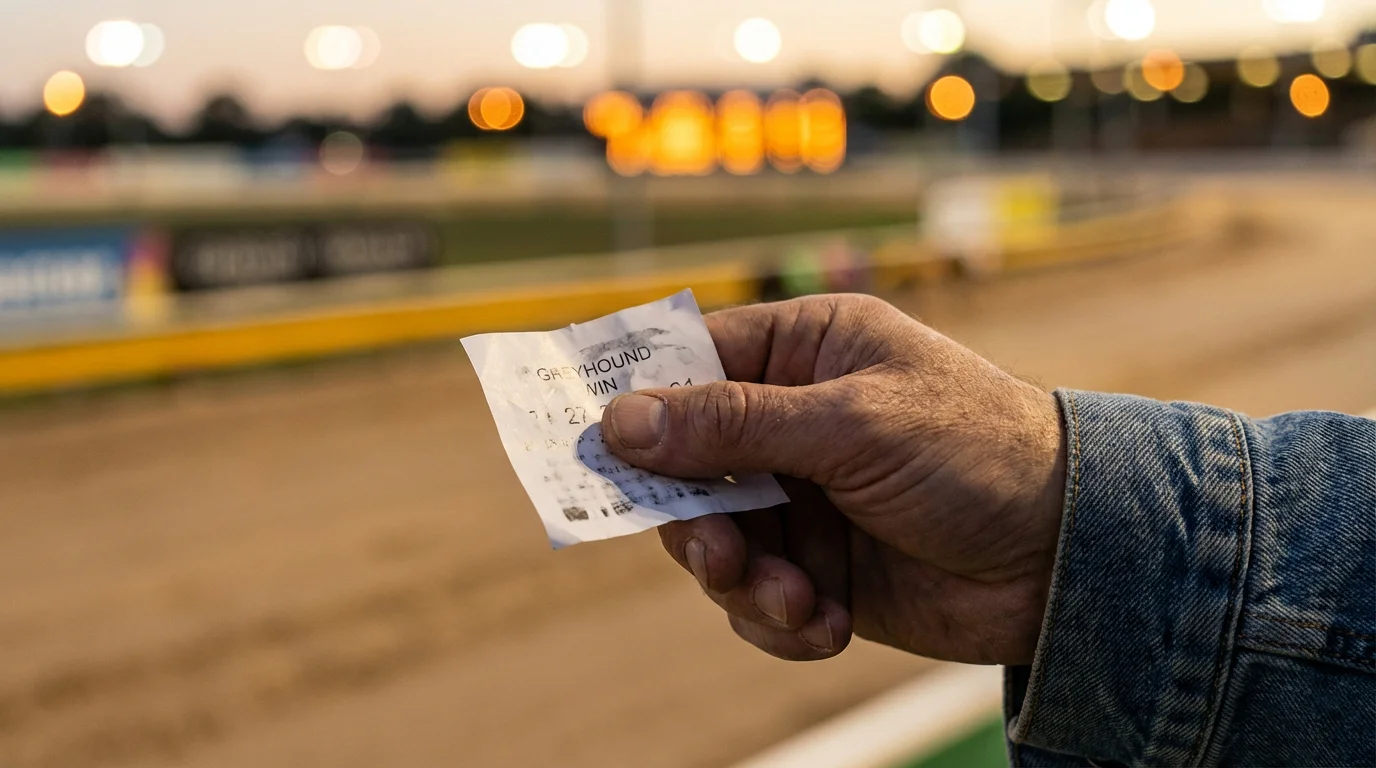
The win bet is the simplest wager in greyhound racing, and also the one that most bettors use most often. Pick a dog. Back it to finish first. If it wins, you collect. If it doesn’t, you lose your stake. No secondary conditions, no partial payouts, no place terms. One dog, first place, that’s it.
That simplicity is both the win bet’s appeal and its underestimation. Because the concept is so easy to grasp, many bettors assume there’s nothing more to learn about it. They’re wrong. How you calculate returns, when win-only beats each-way, and where value hides even at short prices are all questions that the win bet raises and that most recreational punters never bother to answer. This article covers the mechanics, the maths, and the moments when a straightforward win bet is the sharpest tool in your betting kit.
How the Win Bet Works
A win bet is a single selection backed to finish first in a race. You choose one dog, you stake your money, and the bet settles based on one outcome: did that dog win or didn’t it? There are no consolation prizes. Second place, by a neck or by ten lengths, returns the same result — a losing bet.
In greyhound racing, win bets can be placed at fixed odds or at starting price. Fixed odds mean you accept a specific price at the time you place the bet, and that price is locked in regardless of what happens to the market before the off. If you take 5/1 on a dog and the price drifts to 8/1 by the time the traps open, you still get paid at 5/1. If it shortens to 3/1, you still get 5/1. Starting price means you accept whatever the official odds are at the moment the race begins. SP is determined by the market consensus at the off — the point at which the traps open and no more bets are taken.
Most online bookmakers offer both options, and the choice between them is tactical. If you believe the price is fair or likely to shorten, taking fixed odds locks in value. If you think the market might drift — pushing the price higher as other bettors back different dogs — waiting for SP could give you a better return. For many greyhound races, the price movement between the initial market and SP is modest, but on higher-profile races or when significant money enters the market late, the swing can be meaningful.
Win bets are available on every greyhound race at every licensed meeting. There is no minimum or maximum stake imposed by the bet type itself, though individual bookmakers set their own limits. It’s the foundational bet. Everything else in greyhound betting — place, each-way, forecast, tricast — builds on the same underlying question: which dog wins?
Calculating Your Return
The return on a win bet depends on the odds and the stake. The calculation is the same whether you’re dealing with fractional or decimal odds, though the arithmetic looks slightly different in each format.
With fractional odds, the format used by most UK bookmakers, the number tells you the profit relative to your stake. At 5/1, you win five pounds for every one pound staked. A ten-pound bet at 5/1 returns sixty pounds: fifty pounds in profit plus your ten-pound stake back. At 2/1, the same ten-pound bet returns thirty pounds. At 1/2 — an odds-on price — you win one pound for every two staked, so a ten-pound bet returns fifteen pounds. The shorter the price, the smaller the profit relative to the risk.
Decimal odds express the total return rather than just the profit. An odds of 6.00 in decimal format is the same as 5/1 fractional. A ten-pound bet at 6.00 returns sixty pounds. The conversion is simple: decimal odds equal (numerator divided by denominator) plus one. So 5/1 becomes (5/1) + 1 = 6.00. And 1/2 becomes (1/2) + 1 = 1.50, meaning a ten-pound bet returns fifteen pounds total.
One calculation most bettors skip is implied probability. Every set of odds implies a probability that the dog will win. At 5/1, the implied probability is roughly 16.7 percent. At 2/1, it’s about 33.3 percent. At evens (1/1), it’s 50 percent. Understanding this helps you assess whether the price reflects your own estimation of the dog’s chances. If you believe a dog has a 25 percent chance of winning and the market is offering 5/1 — which implies only a 16.7 percent chance — the bet has positive expected value. That gap between your assessment and the market’s is, in essence, what value betting means.
When Win-Only Is the Smart Play
The win bet gets overlooked when bettors start exploring more complex markets. Forecasts, tricasts, and each-way bets feel more sophisticated, and sophistication is often mistaken for superiority. But there are specific scenarios where a straight win bet is the smartest — and most profitable — option available.
The clearest case for win-only is when you’ve identified a strong selection in a weak field. If one dog stands out on form, has a favourable trap draw, and faces opponents that are either out of grade, returning from injury, or simply outclassed, backing it to win is the most capital-efficient bet you can make. Each-way would split your stake and pay a reduced return on the place portion, diluting the value of a selection you believe is likely to win outright. Why hedge when your analysis says the dog should be first?
Win-only also makes sense when the odds are short but your confidence is high. A dog at 6/4 might not excite bettors looking for big returns, but if your analysis gives it a 55 or 60 percent chance of winning, the bet has a positive edge. Each-way at that price would be wasteful — the place return at a quarter of 6/4 is minimal, and you’re adding a second bet for negligible protection. At short prices, win-only keeps the bet clean and the maths honest.
The reverse scenario — when you see some value at longer prices but don’t have strong confidence — is where each-way starts to make more sense and win-only becomes a riskier proposition. The decision isn’t about which bet type is universally better. It’s about matching the bet type to the situation. A win bet works best when your conviction is high, the form picture is clear, and you’d rather concentrate your stake on the outcome you consider most likely than spread it across contingencies.
Sprint races, in particular, lend themselves to win-only betting. The results are more influenced by trap draw and early pace than any other factor, and when those two variables align in a dog’s favour, the probability of winning spikes. In longer races, with more bends and more opportunities for the unexpected, the case for insurance via each-way or place bets gets stronger. But a clean-looking sprint with a well-drawn fast starter? That’s a win bet waiting to happen.
Finding Value at Short Prices
Short-priced favourites carry a stigma in betting culture. Backing a dog at 4/6 or 1/2 feels cautious, even unimaginative. The returns are small, the risk is real, and nobody tells stories about the time they won eighty pence on the pound. But dismissing short prices entirely is a mistake, because some of the most reliably profitable bets in greyhound racing sit at the front of the market.
Value at short prices exists when the implied probability understates the dog’s actual chance of winning. A dog priced at 4/5 has an implied probability of roughly 55.6 percent. If your analysis — based on form, draw, pace, grade, and trainer signals — suggests its real probability is closer to 70 percent, the bet has value regardless of the modest return per stake. Over a large number of bets, that edge compounds. It doesn’t feel dramatic on any single race, but it’s the kind of steady, repeatable return that erodes bookmaker margins over time.
The key discipline is not to back every short-priced favourite reflexively. The market favourite in a greyhound race is the most-backed dog, not necessarily the most likely winner. Favourites win roughly one in three races — a rate that’s lower than many bettors assume and that highlights the importance of being selective even at the front of the market. Your job isn’t to identify every favourite. It’s to identify the favourites whose price underestimates their chances and skip the ones where the price is about right or already too tight.
Staking matters here too. If you’re backing short-priced selections, the profit per bet is small, which means losing runs sting more and the temptation to increase stakes chases. A flat staking approach — the same amount on every bet, regardless of price — keeps the process disciplined. The edge is in the selection, not the stake size.
One Dog, One Price, One Decision
The win bet strips greyhound betting down to its most essential form: you think this dog is going to win, and you’re willing to stake money on that belief. There’s no hedging, no layering, no complexity to hide behind. If you’re right, you profit. If you’re wrong, you lose. That clarity is underrated.
In a sport with dozens of bet types and an industry constantly promoting exotic markets, the win bet can feel unsophisticated. But sophistication isn’t about the structure of the bet — it’s about the quality of the analysis behind it. A well-researched win bet placed at a fair price after thorough form assessment is a sharper tool than a poorly considered forecast or a speculative tricast. The bet type is a vehicle. The analysis is the engine. And the win bet is the vehicle that requires the least maintenance, the least complication, and the most honest answer to the simplest question in racing: which dog finishes first?
Find more bet type guides at centralparkdogresult.
Also see our greyhound bet types guide.
