Greyhound Tricast Bet: How It Works and Payout Guide
Best Greyhound Betting Sites – Bet on Greyhounds in 2026
Loading...
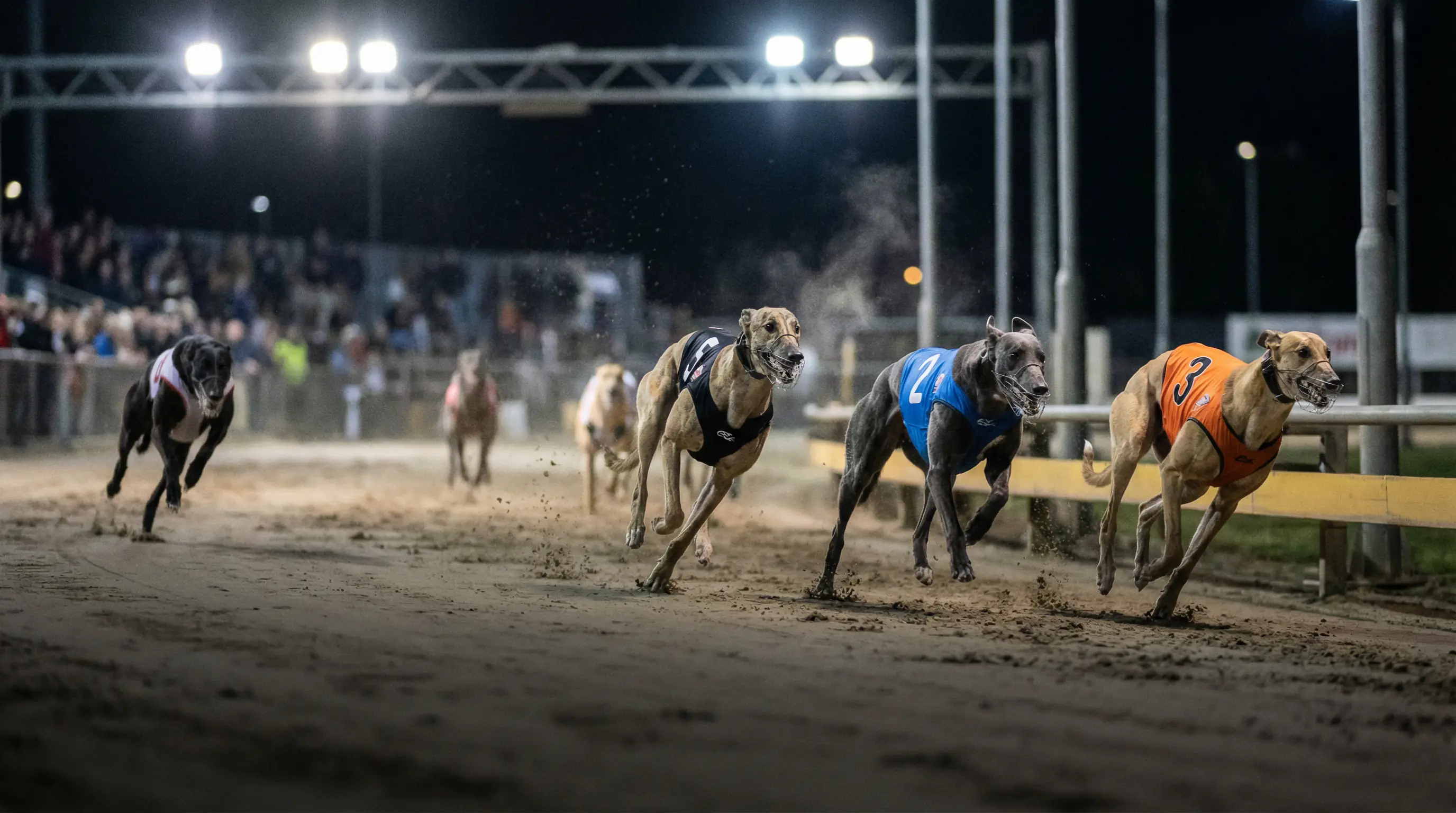
Predicting the first three finishers in order is hard — which is why the payouts can be enormous. The tricast is the most demanding standard bet type in greyhound racing. Where a win bet asks you to identify one dog and a forecast asks for two, the tricast demands you get the top three in the correct finishing sequence. In a six-runner field, there are 120 possible first-second-third combinations. Getting the right one is a 1-in-120 proposition at baseline odds.
That difficulty is reflected in the dividends. Tricast payouts routinely dwarf anything available from win or forecast markets, with returns of fifty, a hundred, or several hundred times the stake not uncommon when the result includes at least one longer-priced dog. The combination tricast loosens the order requirement, and full-cover versions extend to more selections, but every variation still revolves around the same core challenge: naming the top three. This article explains how straight and combination tricasts work, what they cost, and when the risk-reward profile genuinely favours the bet.
How a Straight Tricast Works
A straight tricast requires you to name the first, second, and third finishers in the exact order. You select three dogs and assign each one a specific finishing position. Dog A to win, Dog B second, Dog C third. If that exact sequence occurs, the bet pays out. If any of the three dogs finishes in a different position — even if all three are in the top three but in the wrong order — the bet loses.
Like forecasts, tricast dividends in UK greyhound racing are determined by the tote pool or by a computer tricast calculation rather than by fixed odds. The tote tricast pool collects all stakes on every possible first-second-third combination, deducts the operator’s percentage, and distributes the remainder to winning tickets. The computer tricast uses a formula based on the individual win odds of the three dogs to calculate a declared dividend. In both cases, you won’t know the exact return at the time you place the bet.
The dividend is driven by the popularity of the winning combination. When the first three finishers are the market’s most obvious selections in the most obvious order, the tricast dividend is relatively modest — plenty of bettors backed the same combination, so the pool is split many ways. When the result is unexpected — an outsider finishes second, or the favourite fails to make the top three at all — the dividend spikes, because far fewer tickets covered that specific permutation.
This dynamic means that straight tricasts reward bettors who can identify non-obvious placements. It’s not enough to pick the likely winner. You need to assess which dogs will fill the minor positions and have a reason for the specific order you’ve chosen. That assessment draws on the same analytical tools used for win and forecast betting — form, draw, pace, grade — but applied with an additional layer of detail. Which closer is most likely to pick up third? Which mid-range dog tends to finish just behind the principals without ever quite winning? Those are tricast questions, and they require tricast-level analysis.
Combination Tricast: Covering All Orders
A combination tricast selects three dogs and covers every possible finishing order among them for the top three places. With three dogs, there are six possible permutations: ABC, ACB, BAC, BCA, CAB, CBA. A combination tricast places one bet on each permutation, costing six times the unit stake.
At a two-pound unit stake, a three-dog combination tricast costs twelve pounds. At five pounds per unit, it costs thirty. The arithmetic is simple, but the cost escalates quickly — and that cost is the central tension of the combination tricast. You’re buying complete coverage of three selections across all finishing orders, which means you only need those three dogs to fill the top three in any sequence. The trade-off is that only one of your six bets will actually win, and the dividend from that single winning bet needs to exceed the total cost of all six.
You can also place combination tricasts with more than three selections, covering four or five dogs. With four dogs, the number of permutations jumps to twenty-four. With five, it’s sixty. The coverage increases, but so does the cost — and the dividend per winning unit doesn’t change. A twenty-four-unit combination tricast requires a very large tricast return to break even, let alone profit. In practice, most experienced tricast bettors stick to three-dog combinations, because the cost-to-coverage ratio becomes unmanageable beyond that.
The combination tricast is best suited to races where you have strong confidence in which three dogs will dominate but limited ability to predict the finishing order among them. This happens more often than you might expect. Form analysis frequently narrows the field to three live contenders whose relative positions depend on first-bend dynamics and in-race incidents that are hard to foresee. In those races, the combination tricast lets you express a “top three” opinion without gambling on the sequence.
Cost vs Reward Analysis
The economics of tricast betting are unforgiving. The payouts can be spectacular, but the hit rate is low, and the cost of combination bets adds up fast. Before placing any tricast, the question to answer is: does the expected dividend justify the total stake?
Consider a three-dog combination tricast at five pounds per unit — a thirty-pound total stake across six permutations. If the tricast dividend when those three dogs fill the top three is forty pounds per unit, your winning bet returns two hundred pounds. After deducting the thirty-pound total cost, your profit is one hundred and seventy pounds. That’s a strong return. But if the tricast dividend is only eight pounds per unit — which happens when all three dogs are short-priced and the combination was widely backed — your return is forty pounds against a thirty-pound outlay. A ten-pound profit on a thirty-pound risk is not compelling.
The relationship between the prices of your selected dogs and the likely dividend is the critical variable. Tricasts involving at least one longer-priced selection tend to produce substantially higher dividends, because fewer bettors will have included that dog in their tricast combinations. A tricast of the 2/1 favourite, the 3/1 second favourite, and a 12/1 outsider will pay significantly more than a tricast of the three shortest-priced dogs, even if the former combination is just as analytically sound.
This creates a natural incentive to look beyond the obvious. The most profitable tricast results are the ones that mix an expected winner or two with a less obvious third-place finisher — a dog that the form supports but the market has overlooked. Finding that dog is where tricast analysis diverges from win betting. You’re not looking for the best dog. You’re looking for the dog that most people aren’t looking for.
When Tricasts Offer Genuine Value
Tricasts work best in races with a readable structure but an unpredictable order. That description fits more greyhound races than you might initially think. Because grading keeps fields competitive and the six-runner format limits the variables, many races have three or four dogs that form analysis clearly identifies as the likely top finishers — but determining the exact order among them is genuinely uncertain.
Races with a strong front-runner and two capable closers are classic tricast territory. The front-runner’s position (likely first or second) is partly predictable from split times and trap draw. The closers’ positions relative to each other depend on how much traffic they encounter, how the middle of the race develops, and whether the front-runner fades or sustains its run. Form tells you the cast of characters. The race itself determines the order. A combination tricast captures that dynamic efficiently.
Another favourable scenario is a grade drop situation. When a dog has been dropped in grade and is running against materially weaker opposition, it’s likely to feature prominently in the finish. Pairing that dog with one or two established runners at the current grade level gives you a tricast combination that includes a form standout and runners who know the level. The grade-drop dog may be short-priced for the win, but its inclusion in the tricast doesn’t suppress the dividend as much as three short-priced selections would, because the tricast pool is driven by the combination, not just individual prices.
The golden rule remains selectivity. Tricasts should be occasional bets on races that present a clear analytical picture of the top three, not routine bets placed on every race. The cost of combination tricasts punishes volume. The dividends reward precision. Betting tricasts selectively — maybe one or two per meeting, only when the race structure invites it — is the approach that keeps the cost manageable and the returns meaningful.
Three Places, Six Permutations, One Payout
The tricast is greyhound betting at its most demanding and its most rewarding. It asks you to understand not just the best dog in the race but the shape of the entire finish — who leads, who chases, who picks up the pieces. Getting that picture right, even occasionally, puts you in a market where most participants are guessing and the dividends reflect that gap between informed analysis and random selection.
The tricast isn’t a bet for every race or every bettor. It requires patience, selectivity, and a willingness to lose more often than you win while trusting that the wins, when they come, will more than compensate. That’s a difficult psychological profile to maintain, and most recreational bettors find it uncomfortable. But for those who can read a race from front to back and match that reading to a calculated stake, the tricast is the bet type where greyhound knowledge translates most directly into disproportionate reward.