Greyhound Split Times: How to Use Sectional Data
Best Greyhound Betting Sites – Bet on Greyhounds in 2026
Loading...
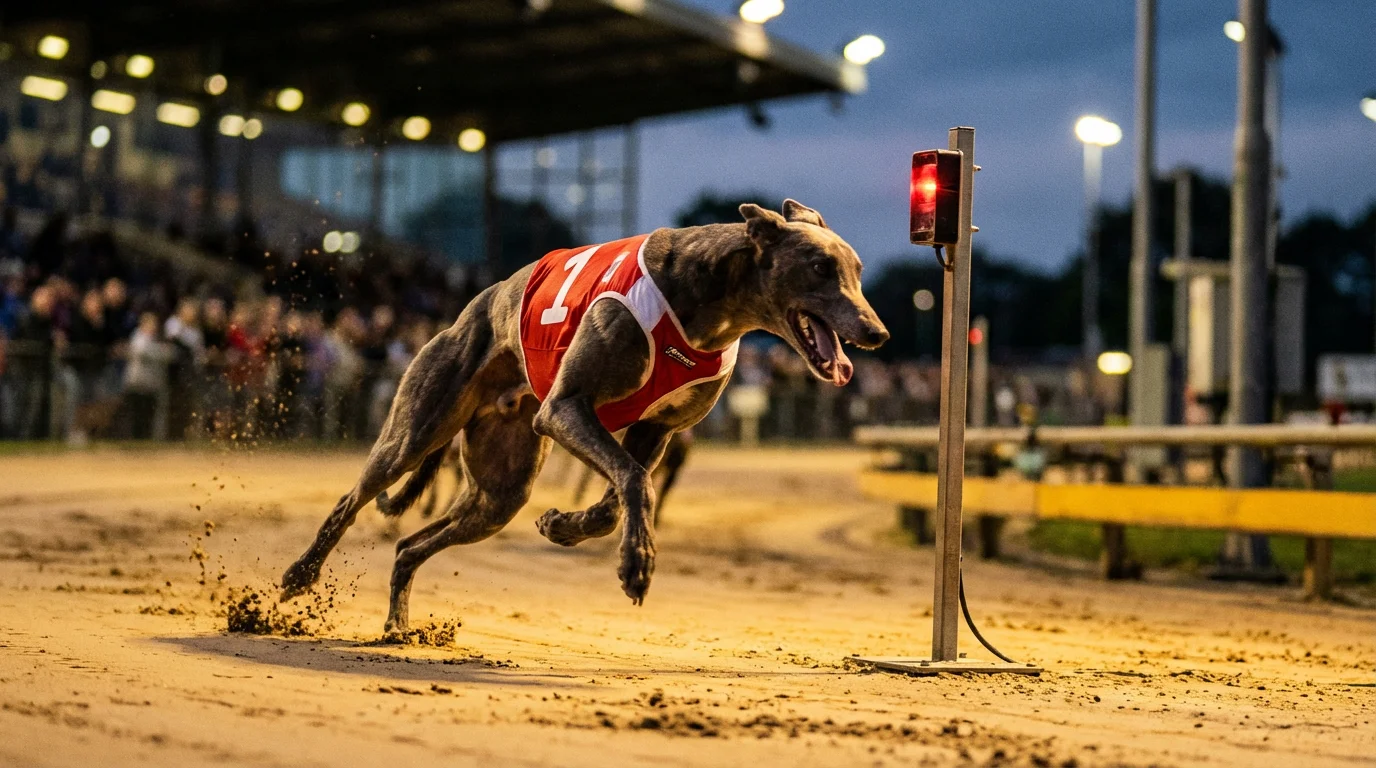
Every greyhound racecard includes a number that most casual bettors glance past: the split time. It’s the time recorded at the first timing point, usually measured as the dog reaches the first or second bend, and it captures something that the finishing time alone never can — how fast the dog started. In a sport where the first bend decides more races than any other single moment, that early-speed data is among the most predictive numbers available.
Split times — also called sectional times — are the foundation of pace analysis in greyhound racing. They tell you which dogs lead early, which settle behind, and how the opening phase of the race is likely to unfold. Combined with trap draw and running style, splits give you a picture of the first bend before it happens. That picture won’t always be right, but it’s based on evidence rather than assumption, and in a sport with tight margins, evidence-based decisions add up.
This article covers what split times actually measure, how to compare them across a field of six runners, where the data can mislead you, and how first-bend position correlates with race outcomes. If you’re not using splits in your analysis, you’re missing the single most informative number on the racecard.
What Split Times Measure
A split time records how quickly a dog reaches the first timing beam, typically positioned near the first or second bend depending on the track. It’s measured in seconds and hundredths of a second, and it captures the dog’s acceleration out of the traps, its initial racing speed, and how quickly it settles into its running stride. On a standard four-bend race, the split time covers roughly the first quarter to one-third of the total distance.
What makes splits uniquely useful is that they isolate the phase of the race where the most important tactical action happens. The start, the run to the first bend, and the negotiation of that bend determine racing positions for the rest of the event. A dog that reaches the first bend in front has a statistical advantage that holds up across thousands of races. The split time is the numerical expression of that early advantage — or disadvantage.
Split times are recorded for every runner in every race, and they appear in the form lines on the racecard alongside the dog’s trap draw, finishing position, and race remarks. A typical entry might show a split of 4.52 seconds for a standard-distance race, which means the dog reached the timing beam in that time from the moment the traps opened. Faster splits indicate a dog that broke quickly and gained an early position. Slower splits indicate a dog that was either slow out of the traps, encountered early traffic, or simply doesn’t possess the initial acceleration to lead the field.
Crucially, splits are not the same as finishing times. A dog can record the fastest split in the field and still lose the race if it fades over the remaining distance. Conversely, a dog with a moderate split can win if it has the stamina to sustain its pace while the front-runners decelerate through the final bends. Splits tell you about early speed. Finishing times tell you about overall speed. The relationship between the two — the difference between the split and the finish — reveals something about the dog’s stamina profile and running style that neither number captures on its own.
How to Compare Splits Across a Field
Comparing splits across a six-dog field is where sectional data becomes actionable. The goal isn’t to find the dog with the fastest split in absolute terms — it’s to map out how the first bend is likely to play out based on each runner’s pace profile and trap position.
Start by listing the split times from each dog’s most recent races at the same distance. Look at the last three to five runs, because a single split can be anomalous — affected by a slow start, early interference, or unusual going conditions. What you’re looking for is a pattern. A dog that consistently records splits of 4.48 to 4.52 over four-bend races has an established early-pace profile. A dog whose splits vary from 4.40 to 4.65 is less predictable, and that inconsistency is itself useful information.
Once you have a pace profile for each runner, overlay it with the trap draw. The dog with the fastest typical split drawn in trap one is almost certainly going to lead into the first bend. The dog with the second-fastest split drawn in trap two will likely be close behind. Now look for conflict zones: two dogs with similar fast splits drawn in adjacent traps. When that happens, the first bend becomes contested, and one of those dogs will almost certainly lose ground. Sometimes both will, if the crowding is severe enough.
The dogs with slower splits are your closers — the runners who sit behind early and try to pick up ground through the later stages of the race. Their splits tell you they won’t lead, which means their race depends on getting a clear run through the pack and having enough stamina to overtake fading front-runners. Closers are harder to assess because their success depends on race dynamics that are less predictable than early pace.
A practical approach is to rank the field by typical split time and then assess whether the trap draw supports or contradicts each dog’s pace profile. The strongest positions are fast dogs with favourable draws. The weakest are fast dogs with unfavourable draws, because they have the pace to lead but may not have the path. Dogs in the middle — moderate splits, moderate draws — are where the race gets uncertain, and uncertainty is where odds are most likely to be mispriced.
One important nuance: compare splits from the same track where possible. Split times are not standardised across venues because the position of the timing beam varies. A 4.50 split at one track might represent a different level of early pace than a 4.50 at another, simply because the beam is placed at a different point.
When Split Data Misleads
Split times are powerful, but they are not infallible. There are specific situations where the split tells you something other than what it appears to, and recognising those situations is part of using the data competently rather than just mechanically.
The most common misleading split is one produced under interference. If a dog was slow away from the traps — noted on the racecard as SAw (slow away) — its split time will be artificially slow. That number doesn’t reflect the dog’s pace ability; it reflects a poor start on that particular occasion. Similarly, a dog that was bumped or checked early in the race (Bmp, Crd) will record a slower split than it would under clean conditions. Whenever a slow split accompanies a race remark indicating trouble, discount it and weight the clean-run splits more heavily.
Going conditions affect splits too. A “fast” going — firm, dry sand — produces quicker times overall, including quicker splits. A “slow” going — wetter, heavier surface — slows everything down. If you’re comparing splits from two different meetings, check whether the going was similar. A dog that recorded 4.52 on slow going might be faster than a dog that recorded 4.50 on fast going, once you adjust for conditions. Calculated times exist for finishing times but not always for splits, which means the adjustment for going often has to be done by eye rather than formula.
Distance matters as well. Splits from sprint races are not comparable to splits from standard-distance races at the same track, because the timing beam may capture a different phase of the run. Even at the same distance, a sprint split covers a larger proportion of the total race than a split from a longer event, so the relationship between the split and the outcome carries different weight.
Finally, there’s the trap effect. A dog drawn in trap one might record a faster split partly because it has the shortest path to the first bend, not because it’s inherently faster out of the traps. The trap position can flatter or penalise the split time independently of the dog’s actual pace. Comparing splits without accounting for the trap each dog ran from is a common analytical shortcut that produces unreliable conclusions. The best splits to compare are those from the same trap position across different races — though getting a meaningful sample from the same trap isn’t always possible.
First-Bend Position Correlation
The dog that leads at the first bend wins more often than any other single variable predicts. That’s the central statistical finding behind using split times as a selection tool, and the data backs it up consistently across tracks, distances, and grades.
The correlation works because greyhound racing is a sport of limited overtaking opportunities. The track has four bends and two straights, and every bend compresses the field. A dog leading at the first bend has clear air ahead of it, no traffic to navigate, and can run the racing line of its choice — typically the rail. Every other dog in the field has to either maintain pace while dealing with traffic or find a gap to move through, both of which cost time and energy.
That positional advantage compounds through the race. The leader at the first bend is frequently still leading at the second bend, and if it’s leading at the third bend, the probability of it winning becomes very high. Late-closing dogs do win — greyhound racing wouldn’t be worth betting on if front-runners won every time — but they win against the odds, both statistically and literally. The market knows that front-runners have an edge, which is why dogs with fast splits and favourable draws tend to be shorter in the betting.
For bettors, the first-bend question is the most important tactical question in race assessment: who is going to lead, and how much competition will they face getting there? Split times give you the raw pace data. The trap draw tells you the geometry. Combining the two produces a forecast of the first bend that, while never certain, is grounded in the best available evidence. When your forecast of the first bend aligns with a dog at a price that exceeds its probability of winning, you have a bet.
Speed Without Context Is Just Noise
Speed without context is just noise. A fast split time is meaningless if you don’t know what trap the dog ran from, what the going was, whether it encountered early interference, and how the rest of the field’s pace profiles compare. The number on its own is data. The number in context is analysis.
Split times reward bettors who are willing to do comparative work rather than just scanning for the fastest figure in the field. The fastest split doesn’t always win. The smartest split — the one that combines pace with a clear path to the first bend and a race set-up that allows that pace to translate into a lead — is where the real edge lies. Learn to read splits not as isolated numbers but as pieces of a tactical puzzle, and the racecard starts telling you stories that the casual glancer never sees.