
Greyhound Betting Mistakes: 5 Errors That Cost Punters
 Available in US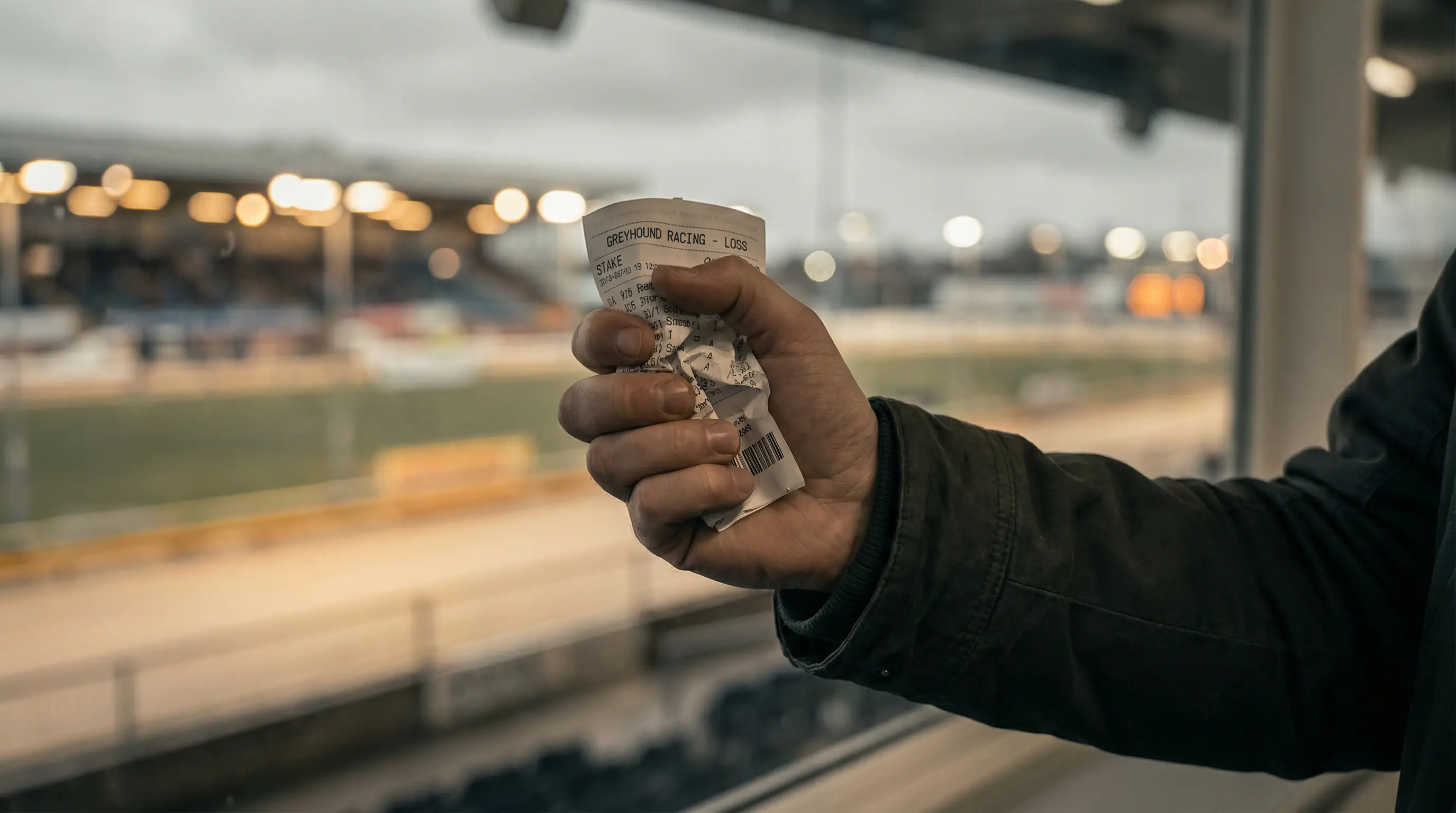
Most greyhound bettors lose. That isn’t a moral judgement — it’s arithmetic. The bookmaker builds a margin into every market, and the majority of punters don’t do the work required to overcome that margin consistently. But the margin isn’t what does the most damage. The most damage comes from avoidable mistakes: errors in process, in discipline, and in understanding that turn a difficult game into an impossible one.
Every mistake on this list is common. Every one is fixable. And every one costs real money to the bettors who keep making them, race after race, meeting after meeting. This isn’t about becoming a perfect analyst. It’s about eliminating the errors that drain your bankroll before your analysis has a chance to work.
Ignoring the Trap Draw
The trap draw is the most statistically significant factor in greyhound race outcomes, and it’s also one of the most frequently overlooked by casual bettors. A dog’s finishing position on any given night is influenced more by which trap it breaks from — and how that trap interacts with the traps around it — than by almost any other variable on the racecard.
The mistake isn’t ignoring trap numbers altogether. Most bettors glance at the draw. The mistake is failing to assess draw quality in context. A dog drawn in trap one isn’t automatically well drawn — it depends on whether it’s a railer, what the dog in trap two does, how the first bend plays at that specific track, and whether the run-up distance favours inside breaks. A dog drawn in trap six isn’t automatically poorly drawn if it’s a confirmed wide runner at a track where the outside bias is minimal.
The fix is to build trap-draw analysis into your routine for every race. Check the draw against each dog’s running style. Cross-reference with the adjacent traps. Consider the track’s bend geometry and any published trap statistics. This takes two minutes per race and changes the quality of your selections more than any other single adjustment.
Backing Favourites Blindly
Favourites win roughly a third of greyhound races. That means they lose roughly two-thirds of the time. Backing the favourite in every race, at whatever price is available, is a strategy that produces a steady, predictable loss over time — because the prices on favourites already reflect their higher probability of winning, and the bookmaker’s margin ensures those prices are slightly too short to be profitable in aggregate.
The mistake isn’t backing favourites. Some favourites represent genuine value, particularly when the market underestimates a dog’s chances based on a superficial reading of the form. The mistake is backing them without assessing whether the price compensates for the probability. A favourite at 6/4 that you believe has a 50 percent chance of winning is a value bet. The same favourite at 4/6 when you give it a 55 percent chance is not. The assessment matters more than the status.
Blind favourite-backing is often a shortcut — a way to bet on a race without doing the analysis required to form an independent view. If you find yourself consistently backing the shortest price in the market because you can’t find a reason to oppose it, you’re not betting. You’re following the crowd, and the crowd doesn’t beat the margin either.
Chasing Losses After a Bad Night
Chasing losses is the most destructive habit in betting, and greyhound racing’s rapid-fire schedule makes it uniquely easy to do. Races run every fifteen minutes. A losing run of three or four races takes an hour. In that hour, the temptation to increase stakes on the next race — to get back to even before the meeting ends — is powerful, immediate, and almost always wrong.
The mechanics of chasing are simple and brutal. You lose twenty pounds over four races. You double your stake on the fifth to recover. If that one loses, you’ve now lost forty. The sixth race becomes a desperation play — larger stake, less considered selection, higher emotional investment. The losing run deepens because the decisions get worse, not better, as the stakes rise and the analysis is replaced by hope.
The fix is a session stop-loss: a predetermined amount you’re willing to lose in a single session, after which you stop betting. Not “take a break.” Stop. Close the app, leave the track, do something else. The amount doesn’t matter as long as it’s set before the session starts and enforced without exception when it’s reached. Every serious bettor who sustains long-term activity has a stop-loss. Every bettor who blows their bankroll in a single night doesn’t.
Betting Without Reading the Racecard
It’s remarkable how many greyhound bets are placed without the bettor having looked at the racecard beyond the dog’s name and the odds. The racecard is the richest source of race-specific information available — form lines, split times, calculated times, race remarks, trap draw, grade, going, trainer, weight — and it’s available for free on every bookmaker’s platform. Ignoring it is like entering a pub quiz without reading the questions.
The race remarks column alone, as covered elsewhere on this site, compresses the narrative of each dog’s recent races into a few abbreviations that explain why results happened — not just what they were. A dog that finished fifth with a Bblk1 notation had a fundamentally different race from a dog that finished fifth with an AlwBhd. One was interfered with. The other was outclassed. The distinction changes your assessment entirely, and it’s sitting right there on the card for anyone who bothers to read it.
The habit to build is simple: never bet on a race you haven’t read the card for. That doesn’t mean spending thirty minutes on every race. It means spending two to three minutes reviewing the form lines, the draw, the remarks, and the key figures before forming a view. If you can’t spare two minutes, you don’t have a view — you have a guess. And guesses, over time, lose.
Overlooking Grade Context
A dog’s grade tells you the standard of competition it’s been racing against, and ignoring it leads to comparisons that look valid on paper but fall apart in practice. A dog that has won three of its last five races in D3 is not the same proposition as a dog that has won three of its last five in A2. The raw win count is identical. The quality of opposition is miles apart.
Grade context is particularly important when dogs move between levels. A drop in grade — from A3 to A5, for example — puts a dog against weaker opposition and should, on ability, improve its chances. The market often reflects this, pricing the grade-dropper as favourite. But the flip side is also true: a dog promoted after winning at a lower grade is now facing faster, more competitive opponents, and its recent form may flatter it. Wins at D1 don’t guarantee competitiveness at B3.
The mistake is treating form figures as absolute rather than relative. Every result is produced in a specific competitive context, and that context is defined by the grade. Check the grade for each run in a dog’s form line. Note whether it’s been moving up, down, or staying level. Ask whether the upcoming race represents a step up, a step down, or more of the same. That context transforms raw form into meaningful form — and meaningful form is the only kind worth betting on.
Five Ways to Lose — and One Way to Stop
The mistakes in this article are all variations on the same underlying problem: betting without process. Ignoring the draw is a process failure. Backing favourites blindly is a process failure. Chasing losses is a discipline failure, which is a subset of process. Skipping the racecard is information failure. Missing grade context is analytical failure. Each one, individually, costs money. Together, they guarantee it.
The one way to stop is to build a process and follow it. Decide before the meeting what your staking rules are, which races you’ll consider, and what constitutes a selection worthy of your money. Read every racecard. Assess every draw. Check every grade. Set a stop-loss and honour it. None of these steps requires genius. They require consistency, and consistency is the one quality that separates bettors who survive from those who don’t.
You won’t win every bet. You won’t even win most bets. But if you eliminate the avoidable mistakes — the ones that hand money to the bookmaker before the race is even run — you give your analysis the best possible chance of doing what it’s supposed to do: finding value, protecting capital, and keeping you in the game long enough for the good bets to outnumber the bad ones.
Get expert tips at centralparkdogresult.
Also explore our greyhound betting strategy.
