
Greyhound Going Allowance and Calculated Time Explained
 Available in US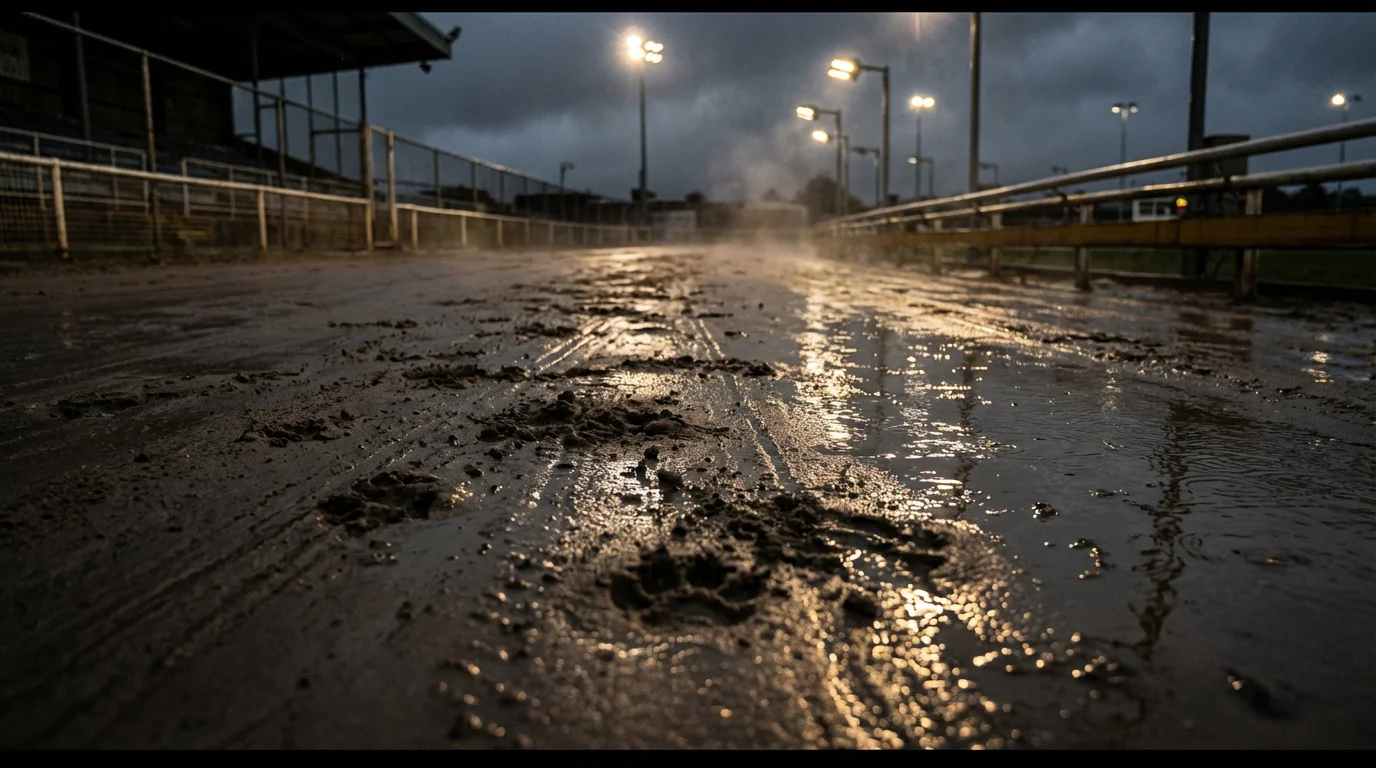
A greyhound finishes in 29.45 seconds on Monday night. The same dog runs 29.72 on Saturday morning. Did it get slower? Maybe. Or maybe the track was heavier on Saturday, the sand wetter, the surface dragging at every stride. Without adjusting for conditions, you’re comparing two numbers that were produced under different circumstances and treating them as equivalent. That’s the problem going correction and calculated time exist to solve.
Going correction is one of the most important — and most overlooked — concepts in greyhound form analysis. It strips out the effect of track conditions from a dog’s finishing time, producing an adjusted figure called calculated time that allows fairer comparisons across different meetings, different days, and different weather. If you’ve ever wondered why a dog’s form looked inconsistent when the raw times bounced around from race to race, the answer is often the going. This article explains what it means, how the correction works, and why calculated time is the number serious bettors pay attention to.
What Going Means in Greyhound Racing
The going describes the condition of the racing surface at the time a meeting takes place. In greyhound racing, every licensed track in the UK uses a sand surface, and the state of that surface varies depending on moisture, temperature, maintenance, and recent weather. A track that has been watered or rained on runs slower than one that is dry and firm. That variation affects every dog in every race on a given card, and it’s reflected in the race times.
Going is typically expressed in simple terms: fast, normal, or slow. Some tracks and form providers use numerical notation — a going allowance of +10, for instance, means the track is running ten spots (hundredths of a second) slower than its standard benchmark. A going allowance of -10 means it’s running ten spots faster. An allowance of N or 0 means the track is running at its benchmark pace. The number is calculated by the track’s official timekeeper based on trial runs or early-race data, and it applies uniformly to the entire meeting.
For bettors, the going matters because it changes the context in which race times should be read. A winning time of 29.60 on a slow going is not the same performance as 29.60 on a fast going. The first dog was fighting a heavy surface and still ran that time; the second had conditions in its favour. Treating those two figures as identical is a mistake that distorts form comparisons, and it’s a mistake that a surprising number of bettors make. The going is printed on the racecard and in results data. It takes seconds to check and saves hours of flawed analysis.
How Going Correction Works
Going correction is the mathematical adjustment applied to a dog’s raw finishing time to account for the state of the track. The principle is straightforward: if the track was running slow by a known amount, you subtract that amount from the finishing time to estimate what the dog would have run on a standard surface. If the track was running fast, you add to the time. The result is a standardised figure that represents the dog’s performance independently of conditions.
The correction is applied using the going allowance for that meeting. If the going allowance is +15 — meaning the track is running fifteen hundredths of a second slow — and a dog finishes in 29.80, the corrected time would be 29.65 (29.80 minus 0.15). If the going allowance were -10, meaning a fast track, the same 29.80 raw time would adjust to 29.90 (29.80 plus 0.10). The correction always moves the time in the direction of what the dog would have run on a neutral surface.
This isn’t an abstract exercise. Over the course of a dog’s racing career, it runs on surfaces that vary from meeting to meeting and sometimes from race to race within the same card if conditions change. A dog that raced on three consecutive slow-going nights might appear to be getting slower based on raw times alone, when in reality it was running to a consistent standard once the correction is applied. Without the adjustment, its form looks like decline. With it, the form looks stable. That distinction changes betting decisions.
The correction is applied by the track’s timekeeper and appears in official results as calculated time, usually abbreviated to CalcTm on racecards and form guides. Some form providers calculate and display it automatically alongside raw times. Others require you to do the arithmetic yourself, which is simple enough once you know the going allowance for each meeting in the dog’s recent history. Either way, the corrected figure is more reliable than the raw time for any form comparison that spans more than a single meeting.
Calculated Time Explained
Calculated time is the adjusted finishing time that results from applying the going correction. It’s the number that answers the question bettors actually care about: how fast is this dog on a level playing field? Raw time tells you what happened. Calculated time tells you what it meant.
On most UK racecards, CalcTm appears in the form lines as a column alongside raw winning time and going allowance. It’s usually displayed in seconds and hundredths — 29.45, 28.97, 30.12 — and it represents the dog’s estimated performance on a standard (neutral) surface. When you see a star notation next to a CalcTm figure, that typically indicates the dog’s best calculated time over that distance in recent runs. That starred figure is worth noting, because it tells you the peak performance the dog has demonstrated under fair comparison.
The value of calculated time becomes clear when you’re comparing dogs that have been racing at different meetings. Dog A ran 29.50 two nights ago on a +20 going. Dog B ran 29.70 last week on a -5 going. The raw times suggest Dog A is faster. The calculated times tell a different story: Dog A adjusts to 29.30, Dog B adjusts to 29.75. Dog A is indeed faster — but by a larger margin than the raw times implied. Now reverse the going: if Dog A’s meeting had been -5 and Dog B’s had been +20, the gap narrows or disappears entirely. Without CalcTm, you’d be comparing apples to weather systems.
Calculated time is not a perfect measure. It assumes the going correction applies equally to all dogs, which isn’t strictly true — some dogs handle heavy going better than others, and some thrive on fast surfaces. But as a standardisation tool, it’s far more reliable than raw times for cross-meeting comparisons. It reduces noise. It doesn’t eliminate it, but in greyhound form analysis, reducing noise is most of the battle.
Using CalcTm to Compare Dogs
The practical application of calculated time is comparison. When you’re assessing a six-dog race, CalcTm gives you a common currency for evaluating speed across runners that may have raced under very different conditions in their recent outings.
Start by pulling the CalcTm figures from each dog’s last three to five runs at the same distance. Look for consistency. A dog that has posted CalcTm figures of 29.40, 29.38, 29.42, and 29.39 over four recent runs is performing at a stable, predictable level. A dog whose CalcTm figures swing from 29.20 to 29.80 is either inconsistent in ability or has encountered significant interference and trouble that distorted some of those results. Check the race remarks before drawing conclusions — a CalcTm that looks slow might reflect a race where the dog was bumped, checked, or badly hampered rather than a decline in actual speed.
Once you have a reliable CalcTm profile for each runner, rank the field. The dog with the fastest consistent CalcTm over the relevant distance has, on adjusted data, been running faster than the rest. That doesn’t make it an automatic selection — trap draw, grade context, running style, and early pace all matter independently — but it gives you a speed baseline that’s grounded in fair comparison rather than raw numbers skewed by conditions.
Pay particular attention to dogs whose CalcTm at this distance is notably faster than the rest of the field. A gap of two or three hundredths is marginal in a sport measured in fractions of a second. A gap of ten to fifteen hundredths is meaningful. And a dog whose best starred CalcTm is significantly quicker than any other runner in the race deserves serious attention, provided the other factors — draw, pace, grade — don’t actively work against it.
The Clock Doesn’t Lie — But It Does Need Translation
A raw finishing time is a fact about a specific race on a specific surface at a specific moment. It is not, by itself, a fact about the dog’s ability. The same dog can produce wildly different raw times from one week to the next simply because the track changed. If you treat those times at face value, your form analysis is built on shifting ground.
Calculated time is the translation layer. It converts surface-dependent results into surface-independent estimates, giving you a figure that’s closer to the dog’s true level of performance. It’s not magic — no single number captures everything about a greyhound’s racing ability — but it’s the most honest time on the racecard. Bettors who use CalcTm as a core part of their analysis are working with cleaner data than those who don’t. In a sport where the margins between dogs in the same grade can be measured in hundredths of a second, cleaner data is a tangible advantage.
Get more race analysis at centralparkdogresult.
Also read our weather and track conditions for greyhounds.
