
Greyhound Trap Draw: How Starting Positions Affect Races
 Available in US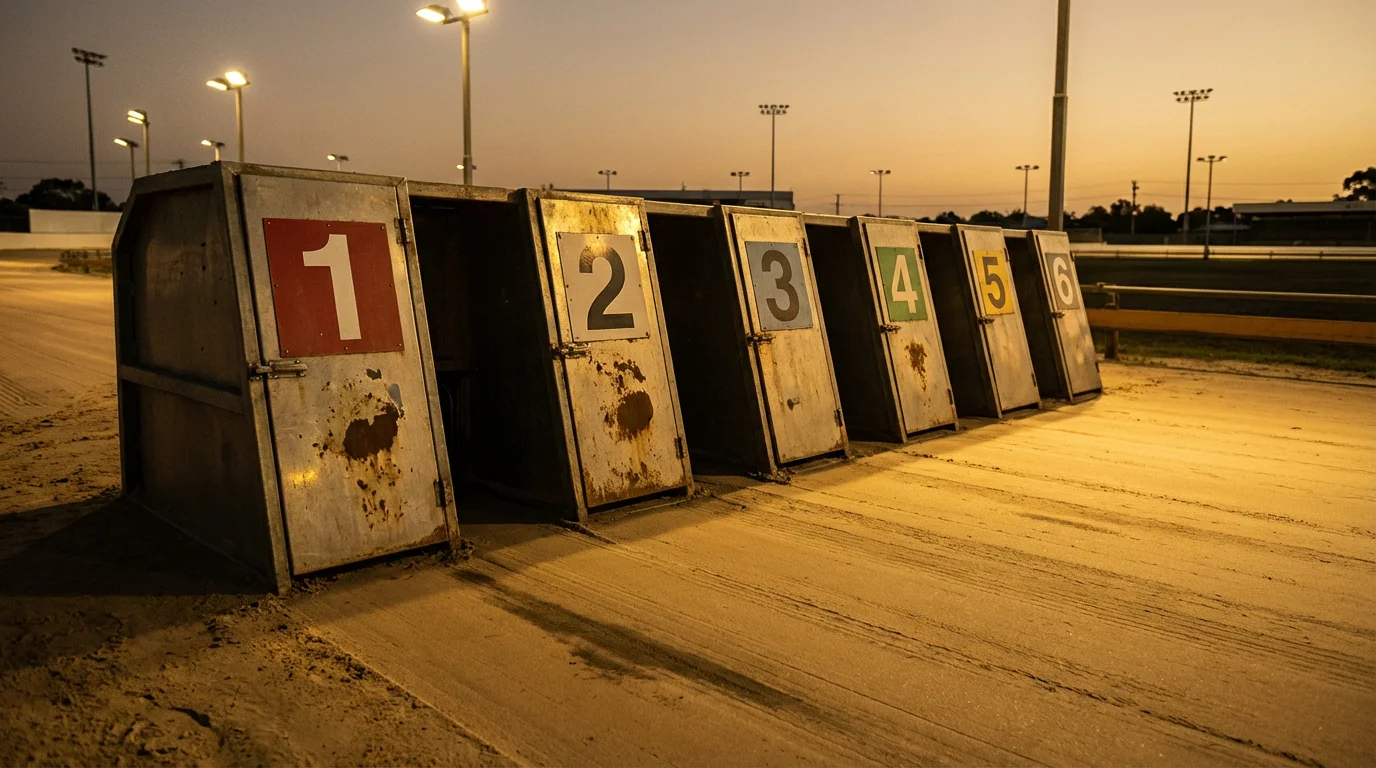
Ask any veteran greyhound punter what matters most and three words come back: draw, draw, draw. It’s a slight exaggeration, but only slight. The trap draw — which starting box a dog is assigned — is the single most immediate piece of information available before you look at a single line of form. It shapes how the race unfolds from the moment the lids open, and it’s the one variable that is visible on the racecard without any further analysis required.
Why does it matter so much? Because greyhound racing is a sport of geometry. Six dogs break from six adjacent traps and funnel into a bend within seconds. Where a dog starts determines its path to that bend, how much clear running it gets, and how likely it is to encounter traffic. A dog with early pace drawn on the inside rail has a fundamentally different race ahead of it than the same dog drawn wide. The draw doesn’t guarantee outcomes, but it sets the conditions under which outcomes happen.
This article explains how trap positions are allocated, how they interact with different running styles, where track-specific biases exist, and how to weight the draw when making your selections. It’s the first variable you should assess — and sometimes the one that makes the rest of your analysis unnecessary.
How Trap Positions Are Allocated
Racing managers don’t assign traps randomly — they match running style to position. This is one of the more misunderstood aspects of greyhound racing among casual bettors. The assumption is that trap draws are a lottery. They’re not. Every dog is categorised by its preferred running line, and the racing manager uses that information to assign trap positions that (in theory) give the dog the best chance of a clear run.
Dogs are classified into three main running styles: railers, middle runners, and wide runners. A railer is a dog that naturally gravitates towards the inside rail once the race is underway. These dogs are typically drawn in traps one and two, giving them the shortest path to the rail and the first bend. A wide runner prefers to race on the outside of the field and is usually assigned traps five or six, where it has space to swing wide without crossing traffic. Middle runners, as the name suggests, tend to race through the centre of the pack and are drawn in traps three and four.
You’ll often see these designations marked on the racecard with letters: (R) for railer, (M) for middle runner, and (W) for wide runner. Some form providers use shorthand like “Rls” (rails) in race comments to describe where a dog ran during its previous starts. These designations aren’t permanent — a dog’s running style can shift with age, fitness, or track conditions — but they’re the starting point for how the racing manager makes draw decisions.
The key insight for bettors is this: when a dog is drawn in a trap that suits its running style, the trap draw is working in its favour. When it’s drawn against type — a railer in trap six, or a wide runner in trap one — the draw becomes an obstacle. It doesn’t make winning impossible, but it increases the likelihood of trouble in running: crowding at the first bend, checked momentum, or a dog expending energy to reach its preferred racing line before it can settle into stride. Those disruptions cost lengths, and lengths cost races.
Running Styles and Trap Interaction
A railer in trap one has a clear path to the first bend. A railer in trap six has five dogs to cross. That asymmetry is where the trap draw shifts from a piece of background information to a decisive factor in the race.
Consider what happens at the start. The traps open and six dogs accelerate forward. Within two to three seconds, they reach the first bend. The dogs on the inside have the shortest distance to travel, both to the bend itself and around it. A railer breaking cleanly from trap one can hug the rail from the start, take the bend on the tightest line, and establish a lead position with minimal interference. That’s the ideal scenario, and it’s why railers drawn low are among the most reliable selections in greyhound betting.
Now picture the reverse. A railer drawn in trap five or six has to cross the entire width of the field to reach the inside rail. In doing so, it risks colliding with other dogs, being shut out by faster starters in the inside traps, or arriving at the first bend wider than it wants to be. Even if the dog has the ability to win the race on pure speed, the draw has created a tactical problem that may cost it several lengths before the race has properly started.
Wide runners face the mirror-image challenge. A dog that naturally races wide and is drawn in trap six has room to swing out around the bend without interference. The same dog drawn in trap one has to navigate through or over the rest of the field to find open space on the outside — a manoeuvre that frequently leads to checking, bumping, or a dog running the entire race closer to the rail than it prefers.
The most dangerous scenarios for bettors involve two fast starters drawn next to each other, especially in adjacent inside traps. When two dogs with strong early pace both want to lead into the first bend, one of them is going to lose that battle. The dog that loses will either check, get bumped wide, or lose its racing position entirely. Reading the racecard for these collision risks is a critical part of trap draw analysis. It’s not enough to know that your selection has a favourable draw — you also need to check whether the dog next to it is likely to cause problems.
Middle runners are the wildcards. Their success often depends less on their own trap and more on what the dogs around them do. A middle runner in trap three with a railer in trap two and a wide runner in trap four may have a clean run. The same dog with two fast starters flanking it may get squeezed before the first bend arrives.
Track-Specific Trap Bias
Some tracks favour inside traps. Others don’t. The data tells you which. Trap bias is a measurable phenomenon — over a large enough sample of races, certain trap positions at certain tracks produce a statistically higher win rate than others. That bias is driven by track geometry: the distance from the traps to the first bend, the tightness of the bends, the width of the track, and how the running rail is set.
At tracks where the run to the first bend is short, inside traps dominate. The dogs in traps one and two simply have less distance to cover before the bend forces the field to compress. There’s no time for a wide runner to establish its line, and the race is essentially decided by who reaches the bend first — which is almost always the dog with the shortest path. Sprint races amplify this effect, because the first bend arrives even sooner relative to the total race distance.
At tracks with a longer run-in to the first bend, the bias flattens out. Dogs have more time to find their racing line, wide runners can swing out before the bend arrives, and the advantage of an inside draw diminishes. On these tracks, raw pace matters more than position, and a fast dog from any trap can lead into the first bend if it breaks quickly enough.
Bend tightness plays a role too. Tight bends compress the field and increase crowding risk, which generally favours the inside trap because the dog on the rail has the least traffic to contend with. Wider, sweeping bends distribute the field more evenly and reduce the penalty for racing wide.
The practical takeaway for bettors is that trap bias data should be track-specific and distance-specific. A trap one advantage at one track over sprint distances doesn’t necessarily apply to the same track over a standard four-bend trip. Results databases and form sites often publish trap statistics by track and distance, showing win percentages for each trap position. These aren’t crystal balls, but they’re base rates — and starting your analysis from an accurate base rate is significantly better than starting from an assumption that all traps are equal. They are not.
Using Trap Draw in Your Betting Process
Trap draw is the first filter — not the last. When the racecard is published and you’re assessing a six-dog race, the trap draw should be the first thing you look at, because it immediately tells you which dogs have conditions in their favour and which ones face a tactical challenge before the race has even started.
Start by identifying each dog’s running style and comparing it to its drawn position. A railer in trap one or two: favourable. A wide runner in trap five or six: favourable. Anything against type: flag it. Then look at the dogs in adjacent traps. Are there two fast starters drawn side by side? Is there a dog with a history of slow starts drawn next to one that breaks hard? These interactions shape the first bend and, by extension, the rest of the race.
The draw matters most in sprint races, where the first bend arrives quickly and there’s less time to recover from a poor start or unfavourable position. In longer races, the draw still matters — especially at the first bend — but a dog with superior stamina or late pace can overcome a moderate draw disadvantage over four bends. Weighting the draw accordingly is part of reading the race as a whole rather than treating any single factor as decisive.
There are also situations where the draw is so bad that it overrides everything else. A strong dog drawn completely against type at a track with a known bias towards the opposite trap is not a good bet, regardless of its form figures. Conversely, a moderate dog with a perfect draw in a weak race is a live contender. The draw doesn’t replace form analysis. It frames it.
Draw Is the Starting Point, Not the Finish
Good draw, bad dog — still a bad bet. But good dog, bad draw? That’s where the real thinking starts. The trap draw is the most accessible piece of information on the racecard, and it’s the one that separates bettors who are doing some analysis from those who are doing none. But it’s also the one that gets over-weighted by newcomers and under-weighted by the complacent.
The draw tells you about the conditions of the race. It tells you who has the advantage at the start, who’s likely to face traffic, and where the first bend is going to be contested. It does not tell you which dog is fastest, fittest, or best suited to the distance. Those answers live in the form lines, the split times, and the grade context. The draw sets the stage. Everything else is the performance. Learn to read the stage first, and the performances start making a lot more sense.
Find more race analysis at centralparkdogresult.
Also read our greyhound trap colours.
