
Greyhound Racing Odds Explained: Fractional, Decimal and SP
 Available in US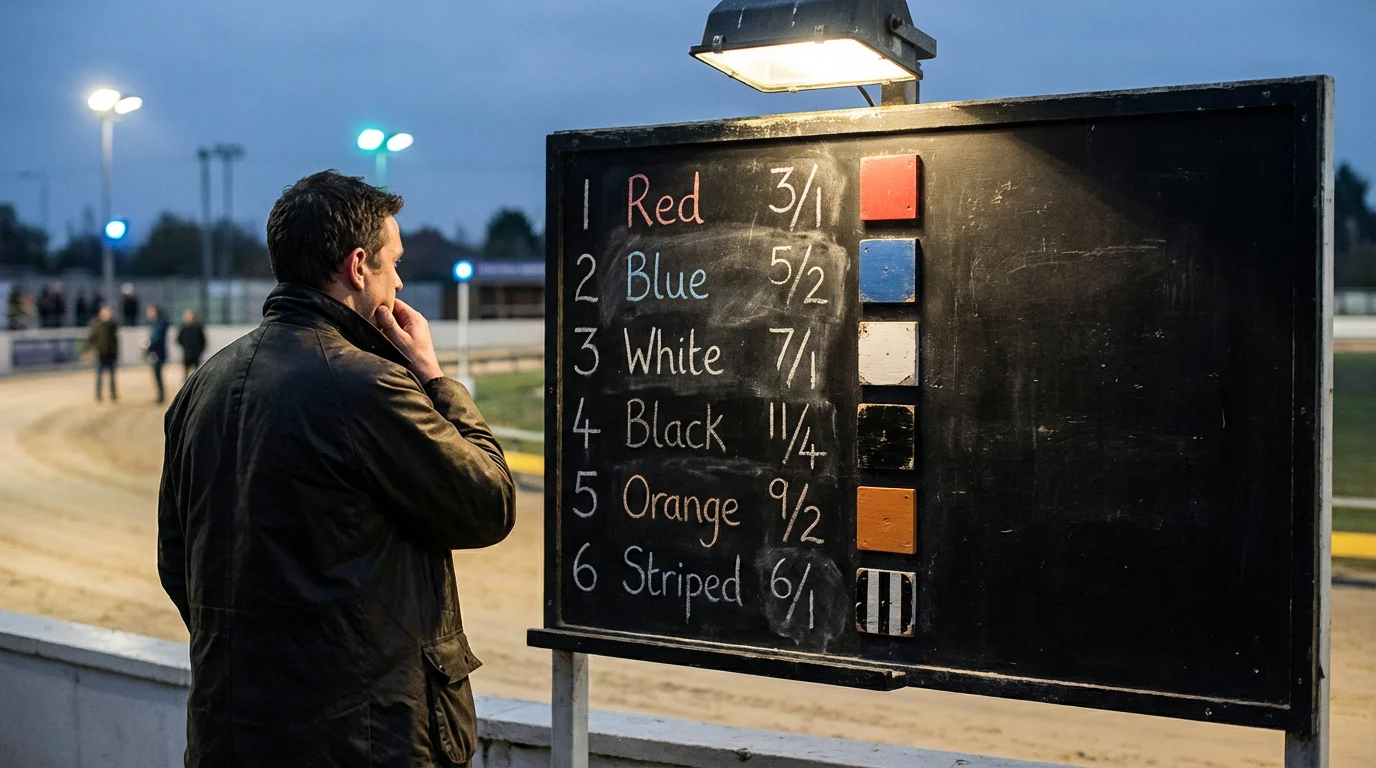
Odds are the language of the betting market — and most punters only speak it at a tourist level. They know that 3/1 means they win three pounds for every one they stake. They know that shorter odds mean a stronger favourite. Beyond that, it gets hazy. How those odds are formed, what they imply about probability, where the bookmaker’s margin sits, why prices move in the final minutes before a race — this is the layer most bettors never reach. And it is the layer where value lives.
In greyhound racing, odds carry extra weight because the markets are thinner and more compressed than in horse racing or football. A six-dog field generates a tighter range of prices, and the margins between true probability and market price can be significant. A bettor who understands how to read odds as data — not just as payout labels — has a measurable advantage over someone who sees 5/1 and thinks only of what they stand to win.
This guide goes beyond definitions. We will cover fractional and decimal formats, but we will also cover how the starting price is determined, how tote pools produce different returns from fixed odds, what implied probability means in practice, and how to calculate the overround to understand exactly how much the market is charging you for the privilege of betting. Odds are not decorative numbers on a screen. They are the most information-dense data point in the entire racecard.
Fractional Odds Explained
3/1 means you win three for every one you risk. But that is just the surface. Fractional odds are the traditional British format and remain the default display at most UK bookmakers for greyhound racing. The number on the left is your potential profit. The number on the right is your stake unit. At 3/1, a ten-pound bet returns forty pounds: thirty in profit plus the ten-pound stake. At 7/2, the same ten-pound bet returns forty-five pounds: thirty-five profit plus stake. The calculation is always profit equals stake multiplied by the fraction, and total return is profit plus stake.
Where fractional odds become genuinely useful is in understanding the three main price zones. Long shots sit above 5/1 — these dogs are considered unlikely to win, and the market rewards you heavily if they do. Mid-range runners typically fall between 2/1 and 5/1, representing dogs with legitimate chances that the market has not marked as favourites. Odds-on runners are priced below evens: 4/6, 1/2, 4/11. With an odds-on shot, you risk more than you stand to win in profit. A ten-pound bet at 4/6 returns sixteen pounds sixty-seven — only six sixty-seven in profit. You are paying a premium for perceived certainty, and in greyhound racing that certainty is less reliable than many bettors assume.
Evens — 1/1 — is the pivot point. At evens, you double your money if the dog wins. Below evens, returns compress; above evens, they expand. The psychological trap is that bettors often feel more comfortable backing odds-on favourites because the win feels likely. But the margin for error at short prices is razor-thin. An odds-on shot needs to win more than half the time just to break even across a series of bets. In a six-dog greyhound race, no dog wins more than half the time over any significant sample, no matter how good its form looks.
One quirk of fractional odds that trips people up: 7/4 is not the same as 2/1, even though the numbers look similar at a glance. 7/4 returns twenty-seven pounds fifty from a ten-pound stake (seventeen-fifty profit). 2/1 returns thirty pounds (twenty profit). That two-pound-fifty difference per ten-pound bet compounds over dozens of wagers. Precision in reading fractional prices is not pedantic — it is the difference between an accurate profit expectation and a vague one. Train yourself to convert fractions into actual pound-and-pence returns before you stake, not after.
Decimal Odds Explained
Decimal odds show total return including your stake — one number, no fractions to decode. Where fractional odds tell you the profit per unit staked, decimal odds tell you the total amount returned per unit. A decimal price of 4.00 means a one-pound bet returns four pounds total: three in profit, one in stake. It is the same as 3/1 in fractional form, but expressed as a single figure rather than a ratio.
The appeal of decimals is their simplicity in calculation. To find your total return, multiply your stake by the decimal price. Ten pounds at 4.50 returns forty-five pounds. Ten pounds at 1.67 returns sixteen pounds seventy. There is no fraction to interpret, no separate profit-and-stake calculation. This makes decimal odds faster to compare across multiple runners. When you are scanning a six-dog racecard and trying to assess whether the second favourite at 4.50 offers better value than the third favourite at 6.00, decimal formatting lets you do that arithmetic almost instantly.
Betting exchanges — platforms where punters bet against each other rather than against a bookmaker — use decimal odds exclusively. So do most European and international sportsbooks. If you use any exchange platform to lay or back greyhounds, you will need to be fluent in decimals. Even among traditional UK bookmakers, the option to switch to decimal display is always available, and many experienced punters prefer it because it removes a layer of mental conversion.
The key landmark in decimal odds is 2.00, which equates to evens. Below 2.00, the dog is odds-on: you get back less in profit than you stake. Above 2.00, the dog is odds-against. The further above 2.00 the price sits, the bigger the return and the lower the market’s assessment of that dog’s chances. A decimal price of 11.00 means the market thinks the dog has roughly a nine percent chance of winning — a rank outsider, but one that pays ten times your stake if it gets there.
There is no mathematical difference between fractional and decimal odds. They express the same information in different formats. But there is a practical difference in usability, and for most analytical purposes — comparing runners, calculating implied probability, assessing value — decimal odds are the more efficient tool. If you are doing any quantitative work with greyhound odds, switch to decimals. The fractions can stay on the bookmaker’s board where they look traditional. Your spreadsheet should speak decimals.
Converting Between Formats
You will encounter both formats. Converting between them should be automatic. The formula is straightforward: to go from fractional to decimal, divide the first number by the second and add one. So 5/2 becomes (5 divided by 2) plus 1, which equals 3.50. To go from decimal to fractional, subtract one, then express the result as a fraction. 3.50 minus 1 equals 2.50, which is 5/2.
For the prices you will see most often in greyhound racing, the conversions are worth memorising. Evens is 2.00. 2/1 is 3.00. 5/2 is 3.50. 3/1 is 4.00. 7/2 is 4.50. 4/1 is 5.00. 5/1 is 6.00. 6/1 is 7.00. 10/1 is 11.00. On the odds-on side: 4/6 is 1.67, 1/2 is 1.50, 4/11 is 1.36. These twelve conversions cover the vast majority of greyhound betting prices. If you know them by heart, you will rarely need to calculate anything in real time.
A useful mental shortcut for less common fractions: if the denominator is 1 (like 7/1, 12/1), just add one to get the decimal. If the denominator is 2, halve the numerator, add one, and you have the decimal: 9/2 becomes 4.5 plus 1, which is 5.50. For denominators of 4, quarter the numerator and add one: 7/4 becomes 1.75 plus 1, which equals 2.75. These shortcuts become reflexive with practice, and they free your concentration for the actual analysis rather than the arithmetic.
Starting Price and How It Is Set
The SP is the final market consensus at the moment the traps open. It is not set by a single bookmaker or algorithm. In UK greyhound racing, the starting price is determined by the prevailing odds in the on-course betting ring at the time the race begins — or, increasingly, by a weighted composite of fixed-odds bookmaker prices and exchange markets. It represents the point at which supply and demand for each dog reached equilibrium just before the off.
Understanding how the SP forms matters because it tells you something the early prices do not: where the real money went. Early-morning prices — sometimes called tissue prices or forecast odds — are the bookmaker’s opening assessment based on form. They are educated guesses. As money comes in through the day, those prices adjust. A dog that opens at 5/1 and drifts to 8/1 has been rejected by the market. A dog that opens at 4/1 and firms to 2/1 has attracted significant support. The SP captures the final state of that process.
For punters who bet before the off at a fixed price, the SP is irrelevant to their payout but useful as a post-race reference. If you backed a dog at 6/1 and the SP was 3/1, you captured substantial value — the market eventually agreed the dog had a better chance than it was given when you placed your bet. If you took 3/1 and the SP drifted to 6/1, you paid a premium for a dog the market lost confidence in. Tracking the gap between your price and the SP over a sustained period is one of the best ways to measure whether you are genuinely finding value or just getting lucky.
When should you take SP rather than a fixed price? Almost never, if you have a choice. Taking SP is a passive decision — you are accepting whatever the market decides. There are rare scenarios where it makes sense: if you expect a dog’s price to shorten significantly because you believe the market has underrated it, taking SP could yield a better return than the current fixed price. But in practice, that is a speculative play. Most of the time, locking in a price you consider value is the better discipline. The SP is useful as a tool for review and learning. It is not a betting strategy.
Tote Pool Odds vs Fixed Odds
With fixed odds, you know your price. With the tote, you are at the mercy of the pool. The distinction between these two systems is not just mechanical — it affects how you should think about the bet itself.
Fixed-odds betting is a contract between you and the bookmaker. You agree on a price at the moment you place the bet, and that price holds regardless of what happens in the market afterwards. The bookmaker carries the risk of having offered a price that turns out to be too generous. You carry the risk that the dog loses. It is a clean, bilateral arrangement, and its main virtue is certainty. You can calculate your exact return before the race runs.
Tote pool betting works on a completely different principle. All money wagered on a particular bet type — win, place, forecast — flows into a collective pool. After the race, the pool operator takes a percentage deduction (the takeout, typically between 15 and 25 percent depending on the pool), and the remaining money is split among all winning tickets. Your return depends not on a pre-agreed price but on how many other people backed the same outcome. If you are the only person in the pool who backed the winner, you get the entire net pool to yourself. If thousands backed the same dog, the dividend per ticket is small.
This pooling mechanism creates a specific dynamic that favours contrarian bets. When a favourite wins, tote dividends are almost always lower than fixed-odds returns because the pool is flooded with money on the obvious choice. When an outsider wins, the tote dividend frequently exceeds the SP because very little money was committed to that outcome. For greyhound punters who specialise in identifying overlooked dogs — perhaps one with a troubled recent run that masked its true ability, or a dog dropping in grade at a track where it has strong course form — the tote can amplify the payoff beyond what fixed odds would deliver.
The flipside is unpredictability. You cannot calculate a tote return before the race. You are betting blind on the payout side, which makes staking decisions harder. A disciplined approach is to use fixed odds for your primary selections — the dogs you back with conviction — and reserve tote pools for speculative bets where you believe the crowd has undervalued an outcome. That way, certainty covers your main action, and the tote handles the edges where its structure works in your favour.
Implied Probability and Finding Value
Every price implies a probability. When that probability is wrong, you have an edge. This is the core principle of value betting, and it is where odds stop being a payout mechanism and start being an analytical tool.
The conversion from odds to implied probability is simple. For decimal odds, divide one by the decimal price. A dog priced at 4.00 has an implied probability of 1 divided by 4, which equals 0.25, or 25 percent. For fractional odds, divide the denominator by the sum of numerator and denominator. At 3/1, the implied probability is 1 divided by (3 plus 1), which is 25 percent. The implied probability tells you what the market believes is the dog’s chance of winning.
Now here is where it gets useful. If you have done your form analysis and you believe a dog has a 35 percent chance of winning, but the market has it priced at 4.00 (implying 25 percent), there is a ten-percentage-point gap between your assessment and the market’s. That gap is value. You are being offered a price that, if your assessment is correct, will produce a positive expected return over time. You do not need to be right every time. You need to be right often enough that the returns at the available price exceed your losses.
The difficulty, of course, is in the accuracy of your own probability estimate. Most punters do not think in probabilities at all — they think in feelings. “This dog looks good” is not a probability estimate. “Based on its calculated times, split-time advantage, and favourable draw, I believe this dog wins roughly one in three times in this grade” is a probability estimate. It might be imprecise, but it is a starting point for comparison against the market price. Over time, tracking your estimates against actual outcomes will sharpen your calibration.
Value betting is not about finding long shots. It is about finding mispriced runners at any point in the odds spectrum. A dog priced at 6/4 (implied probability 40 percent) that you assess at 50 percent is a value bet — even though it is a short-priced favourite. A 10/1 shot that you assess at five percent is not a value bet, despite the attractive payout. The market is overestimating your outsider’s chances if you believe five percent is correct, but a ten percent implied probability at 10/1 means the market already agrees. Value is relative, not absolute. It exists in the gap between market opinion and informed private assessment.
Calculating the Overround
The overround is the bookmaker’s built-in profit margin — and in greyhound racing, it is bigger than you think. In a perfectly fair market, the implied probabilities of all runners in a race would sum to exactly 100 percent. But bookmakers do not offer a perfectly fair market. They shade every price slightly in their favour, and the sum of implied probabilities exceeds 100 percent. The amount by which it exceeds 100 is the overround, sometimes called the vig or the juice.
To calculate it, convert each runner’s odds to implied probability and add them up. In a six-dog greyhound race, a typical set of fixed-odds prices might convert to implied probabilities of 30, 22, 18, 14, 10 and 8 percent. That sums to 102 percent. The overround is two percent — a relatively tight market. But greyhound overrounds are often considerably larger than that, particularly at smaller meetings or in forecast and tricast pools. A 10 to 15 percent overround is not uncommon in standard greyhound win markets, and in exotic pools it can be higher still.
What the overround means in practice is that you are paying a tax on every bet you place. The higher the overround, the more the odds are tilted against you. A 15 percent overround means that even if you could perfectly predict every outcome, the prices offered would return less than your total stake over time. Value betting is, in essence, the practice of finding individual prices where your edge exceeds your share of the overround. It does not eliminate the bookmaker’s margin. It overwhelms it on specific selections where the price is generous enough to compensate.
How Odds Move Before a Greyhound Race
Price movements in the last five minutes before a greyhound race can tell you more than the entire form card. That is an exaggeration — but not by much. Late market moves reflect real money entering the market, and in greyhound racing, where betting volumes are lower and information asymmetry is higher than in mainstream sports, those moves can carry genuine signal.
A dog whose price shortens sharply in the final minutes — from 5/1 to 3/1, for example — is said to be steaming. This usually indicates that informed money, often connected to the kennel or to punters with track-level intelligence, is backing the dog. It does not guarantee a win, but it tells you that people with skin in the game believe this dog is live. Conversely, a dog that drifts from 2/1 to 4/1 is losing market support. The drift might be caused by negative information — a dog that looked flat in the parade, a trainer who has had a poor run — or it might simply be a lack of interest from the market. Either way, the movement is data.
Reading market moves requires context. A steamer at a major Saturday evening meeting, where volumes are high and many eyes are on the card, is less likely to contain inside knowledge than a steamer at a Tuesday morning flapper meeting. The thinner the market, the more a single significant bet can move the price, and the more likely it is that the movement reflects specific information rather than general sentiment. Greyhound markets at smaller tracks are particularly susceptible to this dynamic, which is why some punters monitor price movements as closely as they monitor form.
There are limitations. Market moves can be misleading. A price can shorten because a large recreational bettor placed a big stake without any informational edge. A price can drift because money has concentrated on another runner, not because the drifter is expected to run poorly. Treating every price movement as a signal leads to paralysis or, worse, chasing late money without understanding why it moved. The best approach is to use market moves as a secondary filter: after you have done your form analysis and identified your selection, check whether the market supports or contradicts your view. If your form pick is steaming, that is confirmation. If it is drifting badly, it is worth pausing to ask whether you have missed something the market has noticed.
Odds Are Data — Learn to Read Them That Way
Do not chase short prices. Do not romanticise long shots. Read the odds as evidence. That is the discipline this entire guide has been building towards. Odds are not a wish list. They are not a payout table to scan for the biggest number. They are a market’s compressed assessment of probability, adjusted by the bookmaker’s margin, refined by the weight of money from thousands of individual punters, and shaped by information that ranges from meticulous form study to kennel whispers.
The bettor who understands odds at this level does not look at a 3/1 shot and think “nice return.” They think: the market gives this dog a 25 percent chance. My analysis suggests 33 percent. The overround on this race is 12 percent. Even accounting for the margin, this price is generous. That is a fundamentally different relationship with the numbers on your screen, and it produces fundamentally different results over time.
Greyhound racing is fast, frequent, and data-rich. The odds change by the minute. The markets reset every fifteen minutes at a busy meeting. Every reset is a new opportunity to find a price that does not match the reality underneath it. But you will only see those opportunities if you treat odds as the information they are, not the noise they can appear to be. Learn the formats. Calculate the probabilities. Measure the overround. Watch the movements. The market is talking. Listen.
Find more odds guides at centralparkdogresult.
Also read our best odds guaranteed on greyhounds.
