
In-Play Greyhound Betting: Live Odds and Strategy Guide
 Available in US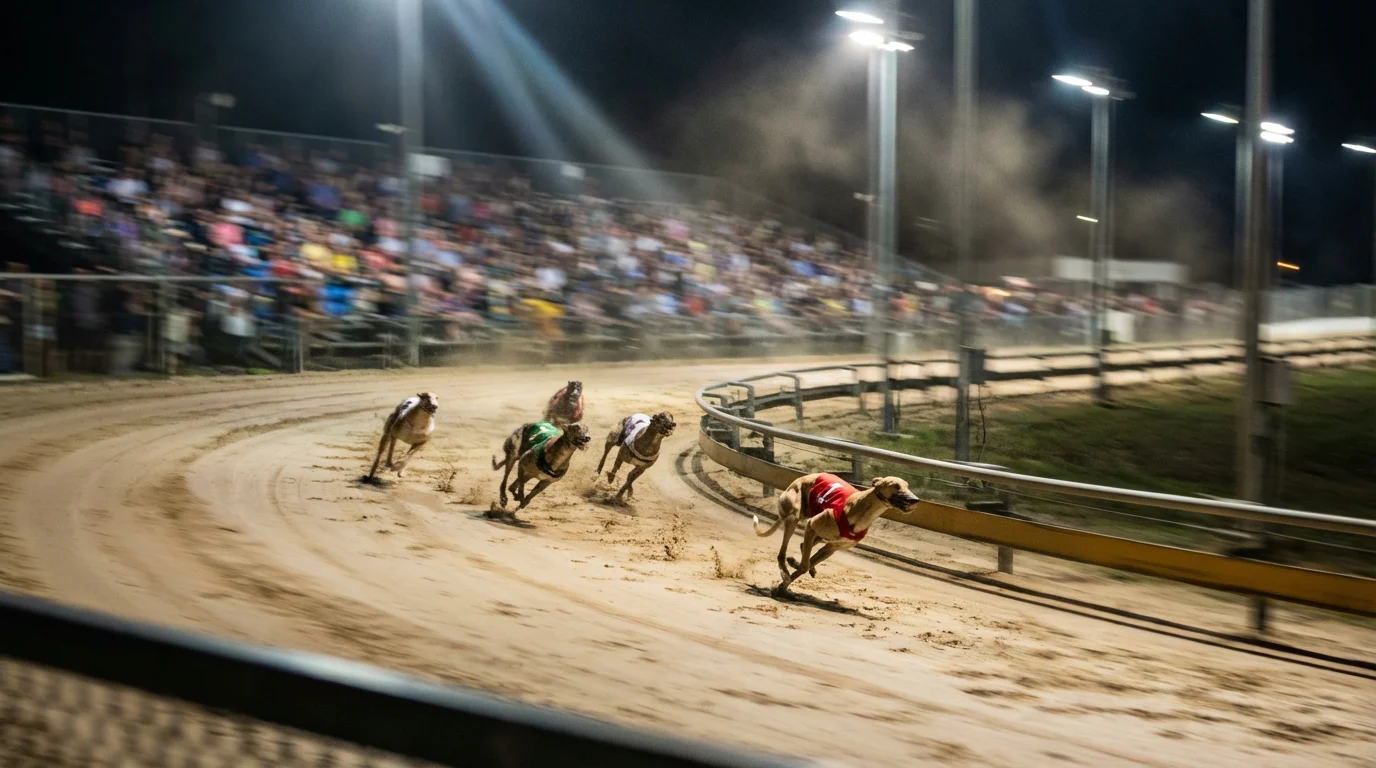
In-play betting on greyhound racing is an exercise in compression. The entire betting window lasts roughly thirty seconds — from the moment the traps open to the moment the first dog crosses the line. Within that window, the market updates, the odds shift, and the opportunity to act exists for a handful of heartbeats before the race is over. This is not horse racing, where an in-play market can run for three minutes across two miles of turf. This is six dogs on a tight oval for half a minute (Towcester Racecourse), and the in-play market exists within the thinnest sliver of time.
That compressed window makes in-play greyhound betting one of the most challenging forms of live sports wagering. The margins between reaction and outcome are measured in fractions of a second. The information available — what you can see on the stream — changes faster than most bettors can process it. This article explains how in-play greyhound markets work, what the timing constraints actually mean in practice, whether any viable strategies exist, and where the risks outweigh the theoretical opportunities.
How In-Play Greyhound Markets Work
In-play greyhound markets are offered by some — but not all — UK-licensed bookmakers. Where available, the market opens when the traps open and closes when the winning dog crosses the finishing line. The odds update in real time based on the position of the dogs during the race, with the leader typically shortening rapidly and the trailing dogs drifting to longer prices as the race progresses.
The technology behind in-play greyhound odds is algorithmic. No human is adjusting the prices during a thirty-second race. The bookmaker’s system receives position data — either from the broadcast feed or from tracking technology at the track — and recalculates the implied probabilities for each dog based on its current position, the distance remaining, and historical patterns for how positions translate into finishing places at that track and distance.
The market is thin by design. Because the race is so short, the volume of in-play bets on any single greyhound race is a fraction of what a horse racing in-play market handles. The bookmaker’s risk management is correspondingly tight: stake limits during in-play are typically lower than pre-race limits, and the available odds may lag behind what’s actually happening on the track by a second or more. That lag is the fundamental challenge of in-play greyhound betting — the price you see may not reflect the current reality by the time your bet is accepted.
Not every bookmaker offers in-play on greyhounds, and those that do may restrict it to specific meetings or specific bet types. Win-only in-play is the most common format. Forecast and tricast in-play markets are rare to non-existent, because the complexity of multi-position betting in a thirty-second window is too great for most pricing algorithms to handle reliably.
The Timing Window: Seconds, Not Minutes
The practical reality of in-play greyhound betting is that the actionable window is approximately ten to fifteen seconds. The first five seconds of a race are dominated by the break from the traps and the run to the first bend. By the time the field has negotiated the first bend and established positions, around five to eight seconds have elapsed. The remaining twenty-odd seconds see those positions largely maintained, with occasional changes through the later bends and the home straight.
The in-play bettor’s window opens after the first bend, when positions are visible, and closes somewhere in the back straight or the third bend, by which point the race’s outcome is substantially determined. That window — roughly ten seconds of useful information between the first bend and the point of near-certainty — is all the time you have to assess the race, evaluate the available odds, and place a bet.
In practice, the window is even shorter. The stream you’re watching has a broadcast delay of one to three seconds, depending on your platform and connection. The bet placement itself takes a second or two — navigating to the market, selecting the odds, confirming the stake. By the time your bet reaches the bookmaker’s system, the race has progressed further, and the odds may have changed. The bookmaker can reject the bet if the odds have moved beyond the accepted tolerance, which happens frequently in a market that’s moving this fast.
This isn’t a complaint about the product. It’s a description of the physics. A thirty-second race with a two-second broadcast delay and a two-second bet placement time leaves a genuine decision window of perhaps five to eight seconds. That’s not a strategic market. It’s a reaction market, and the bettor who succeeds in it needs reflexes, pre-formed decision rules, and a tolerance for rejected bets.
Strategies for Live Greyhound Betting
The word “strategy” needs qualification here. In a ten-second window with lagged information and fast-moving prices, traditional betting analysis doesn’t apply. You can’t study the form during the race. You can’t calculate expected value between the first bend and the second. What you can do — and what the small number of bettors who find in-play greyhound betting worthwhile actually do — is prepare pre-race and execute in-play.
The preparation involves identifying specific scenarios before the race starts. You might decide: “If the trap one dog leads at the first bend and the trap four dog is in second, I’ll back the trap one dog in-play at any price above 1.5.” That decision is made from your pre-race form analysis, where you’ve assessed that the trap one dog is a strong front-runner that rarely gets caught from the lead. The in-play bet is simply the execution of a pre-formed conditional — if X happens, then bet Y.
Laying the favourite is another pre-planned approach. If your pre-race analysis suggests the favourite is vulnerable — poor trapper, susceptible to crowding, tendency to fade — you might plan to lay it in-play if it’s not leading at the first bend. This requires access to a betting exchange rather than a traditional bookmaker, and the exchange’s in-play liquidity on greyhounds is often limited, but the principle is sound: use the in-play market to act on a pre-race view when the early race action confirms (or refutes) your assessment.
What doesn’t work is improvisation. Watching the race unfold and making spontaneous betting decisions based on what you see in real time is a losing proposition, because the broadcast delay means you’re always acting on information that’s already stale and the prices have already moved to reflect the current positions. By the time you’ve processed what you’re seeing, the market has already priced it.
Limitations and Risks of In-Play
The limitations of in-play greyhound betting are structural and unavoidable. The broadcast delay means you’re never seeing the race in true real time. The algorithmic pricing means the bookmaker’s system has already incorporated the positional data before your human eyes have processed it. The thin market means stakes are capped low and bets are frequently rejected.
The psychological risks are significant. In-play betting on greyhounds creates an intensity of engagement that can accelerate impulsive decision-making. The speed of the race, the fast-moving odds, and the pressure to act before the window closes can override the disciplined analysis that should precede any bet. Bettors who find themselves placing in-play bets they hadn’t planned before the race started — reactive bets driven by what they’re seeing rather than what they’ve analysed — are exhibiting exactly the kind of impulse betting that erodes bankrolls.
The financial risk is proportional to the difficulty. In-play greyhound betting has a higher house edge than pre-race betting, because the pricing algorithms build in additional margin to compensate for the speed and volatility of the market. The bookmaker knows it has an informational advantage — its system processes position data faster than any human viewer — and the odds reflect that advantage. You’re betting into a market that is structurally tilted further against you than the pre-race market, and that tilt is by design.
Thirty Seconds of Action, One Moment of Opportunity
In-play greyhound betting exists at the extreme end of live sports wagering. The window is shorter, the information lag is more consequential, and the margin for error is smaller than in any other in-play market. For the majority of greyhound bettors, the pre-race market offers a superior risk-reward profile: more time to analyse, more stable prices, and a structural edge that favours the informed bettor rather than the fastest clicker.
If in-play appeals to you, the path to viability runs through pre-race preparation. Decide your scenarios before the traps open. Define your conditions and your price thresholds. Execute mechanically when those conditions are met, and don’t deviate. The thirty-second race gives you one moment — one genuine moment — where the unfolding action might confirm an opportunity your pre-race analysis identified. Capturing that moment requires discipline that most bettors underestimate and preparation that most bettors skip. Without both, in-play greyhound betting is entertainment dressed up as strategy.
Find more betting guides at centralparkdogresult.
Also read our greyhound betting bankroll guide.
