
Virtual Greyhound Racing: How It Works and Betting Guide
 Available in US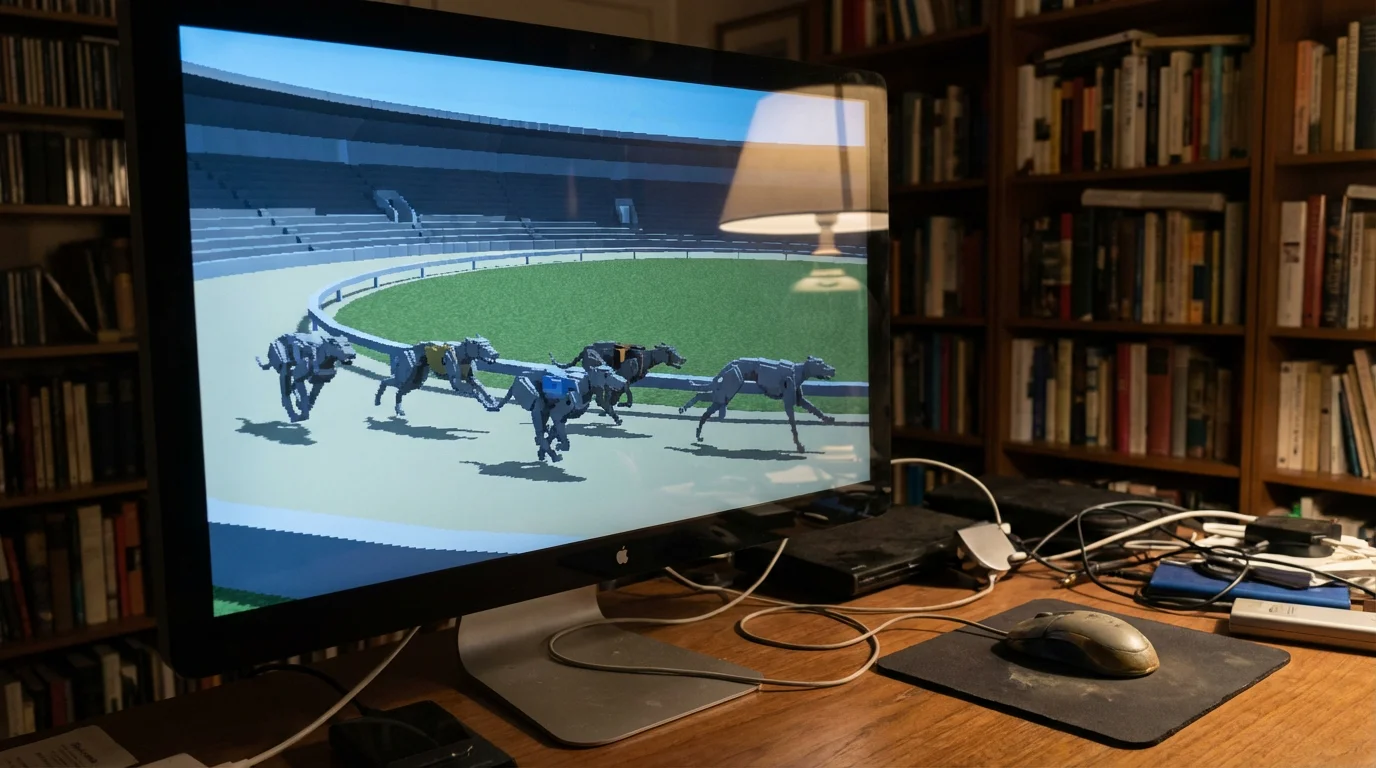
Virtual greyhound racing looks like greyhound racing. The animations show six dogs breaking from traps, sprinting around bends, and crossing a finishing line. The betting markets offer win, forecast, and tricast options. The races run every few minutes, around the clock, with no breaks for weather, welfare checks, or track maintenance. But beneath the surface, virtual greyhound racing is a fundamentally different product from the real thing — and understanding that difference is essential before you place a single bet.
Virtual races are not simulations of real dogs on real tracks. They are computer-generated events driven by random number generators, with outcomes determined by algorithms rather than athletic performance. There is no form, no fitness, no trap draw advantage, and no trainer skill. The visual presentation exists to make the experience feel like racing, but the mechanics underneath are closer to a slot machine with a six-runner animation. This article explains how virtual greyhound racing works, where it differs from real racing, and what — if anything — can be said about strategy in a market designed around randomness.
How Virtual Greyhound Races Work
A virtual greyhound race is a pre-rendered or dynamically generated animation that plays out according to a set of outcomes determined before the visual race begins. The outcome — which dog finishes first, second, third, and in what order — is decided by a random number generator (RNG) the moment the race starts. The animation that follows is a visual representation of that outcome, not a simulation where the result emerges from modelled physics or athletic attributes.
This is the fundamental distinction. In real greyhound racing, the result is uncertain because it depends on physical events — how fast each dog breaks, how the first bend unfolds, how the going affects each runner, whether interference occurs. In virtual racing, the result is determined algorithmically, and the animation is reverse-engineered to match. The race you see on screen is a visualisation of a concluded outcome, not a competition that’s unfolding in real time.
Virtual races run on very short cycles — typically every two to four minutes. There’s no racecard, no form data, and no meaningful information about the runners beyond the names, trap numbers, and displayed odds. The dogs in virtual races don’t carry form from one race to the next. Each race is an independent event with no connection to any previous or future race. The dog that won the last virtual race at trap three has no bearing on what trap three will do in the next one.
The presentation mimics real racing closely enough that a casual viewer might not immediately recognise the difference. The dogs have names, the traps have colours, the commentary describes the action, and the betting interface looks similar to a real-race market. This is deliberate — the product is designed to appeal to greyhound bettors during gaps in the real racing schedule, offering a familiar visual and betting format in a continuously available package.
Odds and RNG: What Determines the Winner
The odds in virtual greyhound racing are set by the software provider based on predetermined probability distributions. Each trap is assigned a win probability for each race, and those probabilities are reflected in the displayed odds. The RNG then selects the outcome in accordance with those probabilities. Over a large number of races, the frequency of wins for each trap at each price point will converge on the mathematical expectation set by the algorithm.
This is important for bettors to understand because it means the odds are the result, not a market opinion about the result. In real racing, odds are set by bookmakers and influenced by public money — they reflect a collective assessment that can be wrong, which is where value betting exists. In virtual racing, the odds directly encode the probability of each outcome. There is no market, no public money, and no collective assessment to disagree with. The price is the probability, minus the operator’s margin.
The operator’s margin in virtual racing is typically higher than in real racing. The overround — the total implied probability across all six runners — is commonly in the range of 115 to 125 percent, compared to 110 to 118 percent in well-traded real greyhound markets. That higher margin means the expected return for the bettor is lower per unit staked, which is the mathematical cost of convenience and availability.
Because the outcomes are RNG-driven, there are no patterns to exploit, no form to read, and no analytical edge to develop. Each race is a statistically independent event. Any apparent pattern — trap one winning three times in a row, for instance — is the product of randomness, not a trend that can be projected forward. The human tendency to see patterns in random data is a cognitive bias, not an analytical insight, and virtual racing is specifically designed around the kind of randomness that triggers that bias.
Virtual vs Real: Key Differences for Bettors
The differences between virtual and real greyhound racing are not cosmetic. They’re structural, and they affect every aspect of how you should approach betting on each product.
In real racing, information creates edges. A bettor who reads the racecard better than the market, who understands trap draw dynamics, who follows trainer form and grade context, has a genuine informational advantage. The market is made up of imperfect human assessments, and when your assessment is more accurate, you profit over time. In virtual racing, there is no information to process. The outcome is random within predetermined probability bounds, and the odds already encode those probabilities. There is no informational edge to find.
Bankroll erosion works differently too. In real racing, a skilled bettor can maintain or grow a bankroll over time by consistently finding value bets where the price exceeds the true probability. In virtual racing, the operator’s margin guarantees that the expected return is negative over any significant number of bets. The higher the margin, the faster the bankroll erodes. This isn’t a skill problem — it’s a mathematical certainty embedded in the product’s design.
The psychological experience is also different. Real racing produces meaningful results that generate new data, update form profiles, and change future markets. Every real race is connected to the races before and after it. Virtual racing produces disposable results that carry no forward information. Each race exists in isolation, which means the bettor receives none of the analytical feedback that makes real racing intellectually engaging over time.
Is There a Strategy for Virtual Dogs?
In any meaningful sense, no. Strategy requires information, and virtual greyhound racing offers none. The closest thing to a strategic approach is disciplined staking — setting a fixed budget, betting small amounts, and treating the activity as entertainment rather than investment. That’s not strategy in the analytical sense. It’s risk management applied to a negative-expectation product.
Some bettors attempt to apply staking systems — doubling stakes after losses, for example — to virtual racing. These systems don’t change the expected return. The mathematics of negative-expectation betting ensures that no staking pattern can convert a losing proposition into a winning one over the long run. Doubling down after losses increases the variance and the speed at which a bankroll can be depleted, without changing the underlying probabilities.
The honest assessment is that virtual greyhound racing is a form of gambling entertainment, not a skill-based betting market. It exists to fill gaps in the racing schedule, to offer instant gratification between real meetings, and to provide a betting product that runs continuously. There’s nothing wrong with enjoying it on those terms — as a quick, low-stakes diversion — but treating it as a serious betting market where analysis and skill produce an edge is a misunderstanding of the product.
Virtual Racing Fills the Gap — It Doesn’t Replace the Real Thing
Virtual greyhound racing occupies a specific niche in the betting landscape: it’s available when real racing isn’t, it’s fast, and it’s easy. For bettors who want to place a bet at three in the morning or during a gap between real meetings, virtual races provide that option. The product serves a purpose, and it does so effectively.
What it doesn’t do is replicate the depth, the challenge, or the intellectual reward of real greyhound racing. There are no racecards to study, no form to decode, no trainers to follow, no trap draws to assess, and no market inefficiencies to exploit. The analytical framework that makes real greyhound betting a skill-based activity doesn’t apply. The data-rich, pattern-rewarding character of the real sport — the quality that makes it worth studying — is absent by design.
If you’re drawn to greyhound betting because of the analysis, the strategy, and the satisfaction of getting a race reading right, virtual racing won’t scratch that itch. If you’re looking for a quick bet while waiting for the next real card, it serves that function. The key is knowing which one you’re doing and adjusting your expectations — and your stakes — accordingly.
Find more racing guides at centralparkdogresult.
Also read our what is greyhound racing.
