
Greyhound Race Distances: Sprint, Standard and Stayers Guide
 Available in US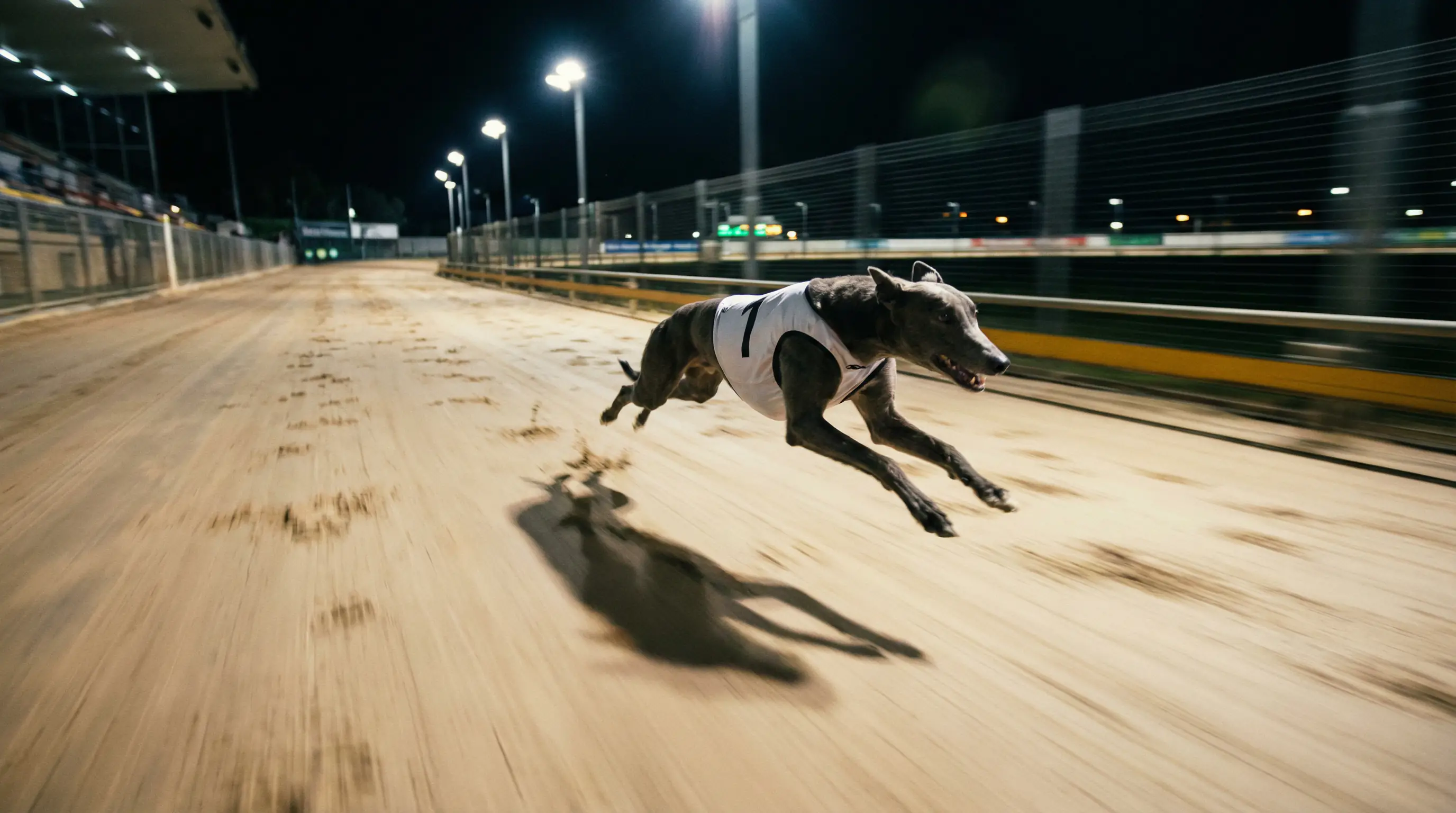
Greyhound racing isn’t one race type repeated over and over. It’s three distinct disciplines — sprint, standard, and stayers — each testing different physical attributes, favouring different running styles, and demanding different approaches from bettors. The distance printed on the racecard determines which attributes matter most, and a dog that dominates over two bends may be entirely wrong over four. Understanding the distance categories and how they shape race dynamics is foundational knowledge for anyone who bets on greyhounds with any regularity.
UK tracks offer distances ranging from around 238 metres at the shortest to over 1000 metres for marathon events, though most racing falls within a narrower band (SIS — Live Racing Content). This article breaks down the three main distance categories, explains what each demands from the dogs, and shows you how to identify a runner’s distance preference from its form — because when a dog is running at the right distance, everything else falls into place more naturally.
Sprint Distances: Under 300 Metres
Sprint races are the shortest events on the card — typically two-bend affairs covering somewhere between 238 and 300 metres depending on the track. They’re over fast. A sprint can be done inside seventeen seconds, which leaves almost no time for tactical positioning, recovery from a bad start, or closing ground from behind. The sprint is a race of absolutes: trap speed, early pace, and the first bend. Everything else is secondary.
The trap draw is at its most decisive in sprints. The distance from the traps to the first bend is short, which means dogs on the inside have a geometrical advantage that’s nearly impossible to overcome. A railer drawn in trap one with a fast split time is the prototype sprint selection — shortest path, fastest start, least opportunity for interference. At tracks where the run-up to the first bend is particularly tight, trap one dominance in sprint races can be statistically overwhelming.
Sprint specialists tend to be explosive, muscular dogs with exceptional acceleration but not necessarily the stamina to sustain their pace over four bends. Their form figures at standard distances may look mediocre — they lead early and fade late — but over a sprint distance, that early speed is the whole race. Identifying a sprint specialist running at its optimal distance versus the same dog stretched over a standard trip is one of the simplest and most profitable form-reading skills in greyhound betting.
The betting markets for sprints can be polarised. Because the race outcome is so heavily influenced by the trap draw and early pace, the favourite is often a strong favourite, and the outsiders are genuine outsiders. This compression of the market means that when the favourite doesn’t win — and it still doesn’t win every time — the returns on an alternative selection can be significant. The sprint is a high-conviction market that rewards certainty and punishes ambiguity.
Standard Four-Bend Races
Standard-distance races are the backbone of UK greyhound racing. Run over four bends — usually between 450 and 500 metres, though the exact distance varies by track — they represent the vast majority of races on any given card. If you bet on greyhounds regularly, most of your bets will be on standard-distance races.
Four-bend racing tests a broader range of abilities than sprints. Early pace still matters — the first-bend advantage is real at every distance — but stamina, tactical awareness, and the ability to handle traffic through the middle bends all play a role. A dog that leads at the first bend but doesn’t have the fitness to sustain that position through four bends can be overhauled by a closer with superior endurance. The standard distance creates more opportunities for the race to change shape between the start and the finish.
This increased complexity makes standard-distance races both harder to predict and richer in analytical opportunity. The racecard data matters more: split times, calculated times, recent grade movements, and race remarks all contribute to a fuller picture than they do in a sprint, where the first two seconds often tell you everything. Bettors who invest time in thorough form reading are most rewarded at standard distances, because there are more variables to assess and more ways for the market to misprice a runner.
The trap draw is still relevant at standard distances, but its influence is moderated by the additional bends. A dog with a moderate draw but strong closing pace can overcome a first-bend disadvantage if the race develops favourably. The field has more time to sort itself out, which means that running style and stamina interact with the draw in ways that the sprint format doesn’t allow. Standard-distance races are where the full toolkit of greyhound form analysis — draw, pace, time, grade, trainer — comes into play simultaneously.
Stayers and Marathon Events
Stayers races cover the longest distances on the card — typically six bends or more, running from around 640 metres up to 1000-plus metres at tracks that cater to marathon specialists. These are the rarest events in the schedule and the most physically demanding for the dogs. Not every track offers stayers distances, and the dogs that compete in them are a distinct subset of the racing population.
Stamina is the defining attribute. In a stayers race, early pace matters far less than the ability to maintain speed through six, eight, or even more bends. Front-runners who burn their energy in the first half of the race are vulnerable to closers who settle behind the pace and pick up ground steadily through the later stages. The form profile of a stayers specialist often looks unremarkable at standard distances — mid-pack finishes, moderate split times, nothing flashy — but over a marathon trip, that consistent, sustainable pace becomes the winning attribute.
Stayers events attract a smaller, more specialised betting market. Because fewer dogs compete at these distances, the form data is thinner and the pool of comparative results is smaller. This can make the market less efficient than the standard-distance market, which creates opportunities for bettors who follow stayers racing specifically. A dog that has been running over standard distances and is stepping up to a stayers trip for the first time is a particular form puzzle — its existing data doesn’t directly tell you whether it has the stamina, and the answer only reveals itself in the running.
Hurdle races were historically run at tracks including Central Park and Crayford, adding a further dimension to the staying category. Hurdle events required dogs to jump barriers during the race, testing athleticism and bravery alongside stamina. However, Central Park stopped racing over hurdles in recent years, and Crayford — the last track to feature hurdles — closed in January 2025, effectively ending hurdle racing in British greyhound racing (SIS Racing). Not all dogs took to hurdling, and the form from hurdle events sat in its own category — a strong hurdler was not necessarily a strong flat racer, and vice versa.
Distance Preference: How to Spot It in Form
Every dog has a distance at which it performs best, and the form data usually reveals it if you know where to look. The key indicators are the relationship between split times and finishing positions, the pattern of race remarks across different distances, and the calculated times relative to the field at each trip.
A dog that consistently records fast splits but fades in the closing stages at standard distances is a sprint candidate. Its early speed is genuine, but its stamina doesn’t match. If the same dog is entered in a sprint race and suddenly produces a winning performance, the distance preference is confirmed. Conversely, a dog with moderate splits that consistently closes ground and shows RanOn or FnlStr in the race remarks at standard distances may be crying out for a longer trip. Its form at 480 metres looks average, but its finishing speed suggests it would thrive over 640.
Grade movements can also signal distance preference. A dog that keeps getting promoted after wins at one distance but struggles when switched to another is likely running into a distance limitation. Trainers don’t always get the distance right immediately, especially with younger dogs whose stamina hasn’t been fully tested. Watching for dogs that have recently been moved to a new distance — particularly one that matches the pattern in their form data — is a productive habit.
Calculated time comparisons across distances offer a more precise tool. A dog whose CalcTm at 480 metres is consistently two or three hundredths faster than the field average, but whose CalcTm at 270 metres is only average, is a standard-distance specialist. The numbers quantify what the race remarks describe qualitatively. A dog running at its preferred distance, at its preferred track, in the right grade, is a dog with multiple factors working in its favour — and that convergence of positive conditions is what produces the highest-confidence selections.
Every Dog Has a Distance — Find It
Distance is one of the most fundamental variables in greyhound racing, and it’s also one of the easiest to misread. A dog’s record at the wrong distance can make it look far worse — or far better — than it actually is. The sprint specialist that looks slow over four bends isn’t a slow dog. It’s a fast dog running the wrong race. The stayer that plods through a standard trip isn’t ungifted. It’s running a distance that doesn’t let its best attribute — sustained pace — emerge.
Matching the dog to the distance is the first thing a trainer tries to get right, and it’s one of the first things a bettor should check. Before you assess form figures, split times, or trap draw, ask whether the dog is running at its optimal distance. If it is, the rest of the analysis sits on a solid foundation. If it isn’t, the rest of the analysis may be answering the wrong question entirely.
Find more race guides at centralparkdogresult.
Also read our graded races explained.
