
Greyhound Early Pace: Why the First Bend Decides Races
 Available in US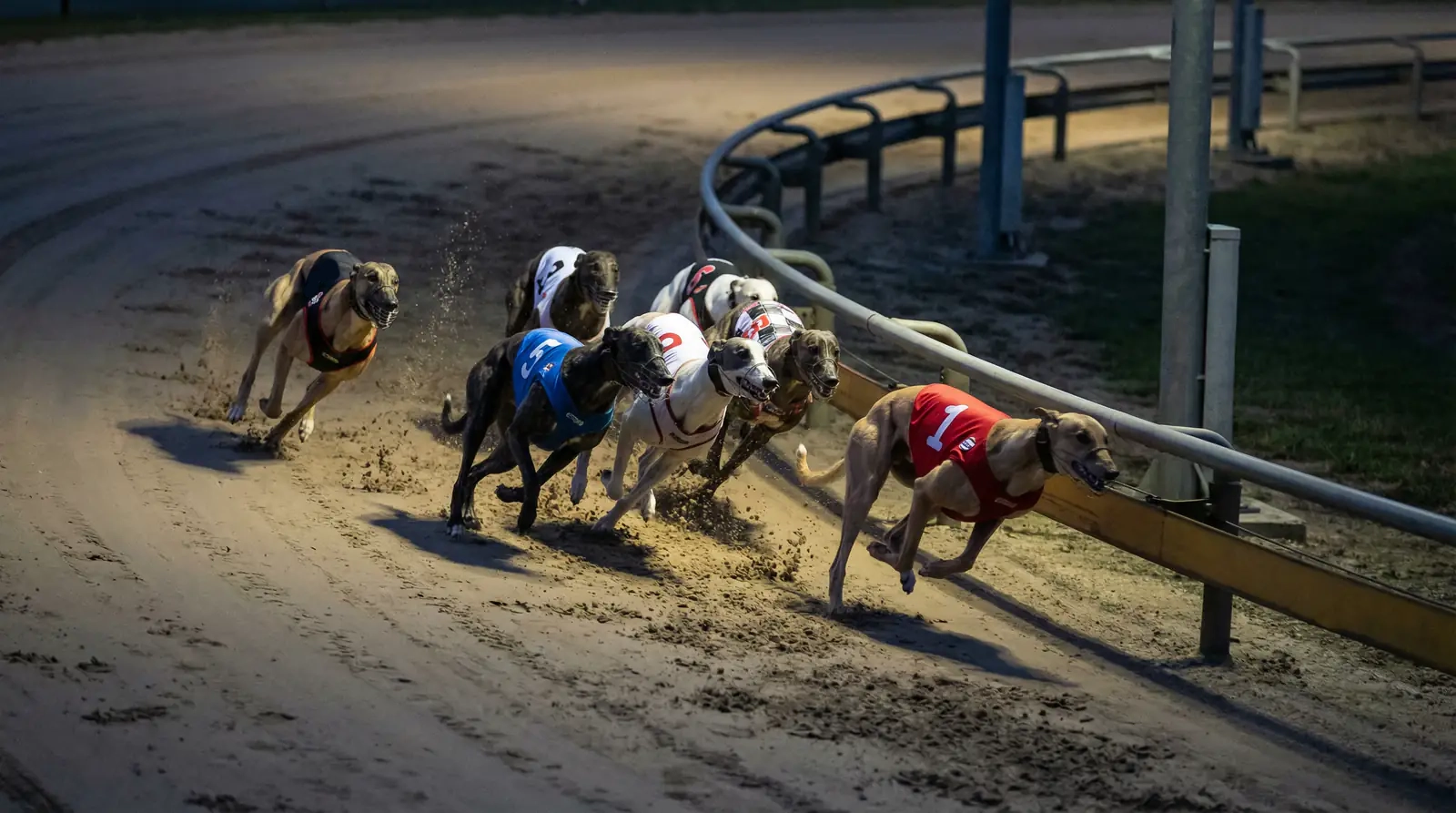
Greyhound races are decided in phases, and the most important phase lasts about two seconds. That’s the time between the traps opening and the field reaching the first bend — a compressed window in which six dogs accelerate from a standstill, establish their racing positions, and funnel into a turn that reshapes the order for the rest of the race. What happens in those two seconds determines more outcomes than any other segment of the race.
Early pace — the speed at which a dog breaks from the traps and covers the opening stretch — is the single most predictive factor in greyhound racing. It can be measured, compared, and used to forecast how the first bend will unfold. This article explains why that bend matters so much, how to read early pace from the racecard, what happens when fast starters are drawn alongside each other, and how to convert pace data into betting selections that are grounded in the strongest available evidence.
Why the First Bend Is the Race
The dog that leads at the first bend wins more often than any other variable predicts. That statement has been validated by decades of results data across UK tracks, distances, and grades. The statistical edge of leading at the first bend is not marginal — it’s the dominant factor. No other single variable, including form, grade, or calculated time, comes close to the predictive power of first-bend position.
The reason is structural. Greyhound racing takes place on an oval track with tight bends that compress the field. A dog leading at the first bend has clear running ahead of it — no traffic, no obstacles, and the choice of the optimal racing line (usually the inside rail). Every other dog in the field faces a different reality: they’re racing in a pack, where the risk of bumping, checking, and crowding is constant. Each bend amplifies this disadvantage, because the field compresses again and the dogs behind the leader have to navigate both the track geometry and the other runners simultaneously.
The leader also benefits from a psychological and physical dynamic that’s specific to coursing breeds. Greyhounds are pursuit animals. A dog in front is running towards the lure with an unobstructed view. Dogs behind are running partly in the wake of the dogs ahead of them, which can affect their visual tracking of the hare and their running efficiency. The effect is subtle but consistent across large sample sizes.
In sprint races, the first-bend advantage is even more pronounced. With only two bends to negotiate, a dog that leads at the first one has already controlled half the race. There’s simply not enough remaining distance for a closer to make up significant ground. In standard four-bend races, the advantage persists but is slightly diluted because the additional bends create more opportunities for position changes — crowding at the third bend can cost the leader, and a dog with strong finishing pace can close the gap through the final straight.
For bettors, the first-bend question is the most important question in any race: who gets there first, and what happens when they do? Every other piece of analysis — form, grade, distance preference, trainer signals — feeds into that central question. If you can forecast the first bend with reasonable accuracy, you’re ahead of most of the market.
Measuring Early Pace from the Racecard
Early pace is measured through split times — the time recorded at the first sectional point, usually positioned near the first or second bend. The split time captures how quickly a dog reached that point from the trap opening. Faster splits indicate stronger early pace. The data is on the racecard, recorded for every run in every dog’s form lines.
To build a pace map for a race, pull the split times from each dog’s recent runs over the same distance at the same track. Consistency matters more than a single fast reading. A dog that has recorded splits of 4.48, 4.50, 4.49, and 4.51 across four clean runs has a reliable early-pace profile. You know what to expect. A dog whose splits range from 4.42 to 4.62 is harder to forecast — its early speed depends on race-day factors that vary from outing to outing.
The racecard abbreviations add context to the split times. A split accompanied by QAw (Quick Away) tells you the dog broke cleanly, and the time reflects its genuine pace. A split accompanied by SAw (Slow Away) tells you the start was compromised, and the time underrepresents the dog’s actual acceleration ability. Discounting slow splits that were caused by poor starts, rather than treating every number at face value, is essential for accurate pace mapping.
Once you’ve established each dog’s typical split, the trap draw completes the picture. Overlay the pace profiles onto the trap positions. The fastest typical split from the innermost trap is your projected first-bend leader. The next fastest from an adjacent trap is the main challenger. Dogs with slower splits from wider traps are your likely mid-pack and closing runners. This layered assessment — split times modified by trap draw and start reliability — produces a forecast of the first bend that is evidence-based and replicable from race to race.
Crowding Risk: When Fast Starters Collide
The most dangerous scenario in any greyhound race is two fast starters drawn in adjacent traps on the inside. When two dogs with similar, rapid split times both want to lead into the first bend from traps one and two — or traps two and three — the bend becomes a contested zone. One dog will get there first. The other will be forced to check, yield, or fight for space. Sometimes both lose ground when neither gives way cleanly.
These collisions are not rare. They happen in graded races at every meeting because the racing manager allocates traps based on running style, not pace (Towcester Racecourse — How Trap Draw Works). Two railers with different split times can end up drawn side by side, and the one with the faster break will cut across the other’s path as both converge on the rail. The result is crowding — noted in the race remarks as Crd1 — and it costs both dogs lengths that they may not recover.
For bettors, crowding risk is a pre-race assessment, not a post-race excuse. Look at the splits and the draws. If two fast starters are drawn next to each other, at least one of them is going to have a compromised run. The question is which one — and whether that compromise will be severe enough to take it out of contention entirely. In sprint races, where the first bend arrives in under three seconds, even a minor check can be fatal to a dog’s chances. In longer races, there may be time to recover, but the positional damage is done.
The dogs that benefit most from crowding at the front are the closers drawn behind or wide of the contested zone. If two inside-drawn front-runners take each other out at the first bend, a middle runner or wide runner with clean passage can inherit a lead position that the pace map didn’t predict. These are the races where the obvious selections both underperform and a less-fancied dog comes through at a price. Identifying those possibilities before the race starts is one of the more profitable applications of early pace analysis.
Using Early Pace Data in Your Selections
Early pace data feeds into selections through a hierarchy of questions. First: which dog is most likely to lead at the first bend? Second: does it have a clear path to get there? Third: if the path is contested, who benefits from the disruption?
When the answers align — a fast dog with a favourable draw and no adjacent pace threat — the selection is straightforward. Back the likely leader, provided the price reflects a reasonable probability rather than an already-compressed favourite’s margin. These are the races where early pace analysis confirms the obvious selection and the question is purely about value at the available odds.
The more interesting applications come when the pace map is contested. A race where three dogs have fast splits and the trap draw creates conflicting lanes is a race where the outcome is less certain — and less certainty means the market is more likely to misprice at least one runner. In these races, the value often sits with the closer or the dog that avoids the contested zone, because the market may be over-pricing the front-runners without fully accounting for the crowding risk between them.
Pace analysis also helps you identify races to avoid. A race where four or five dogs have similar splits from unfavourable draws is essentially a lottery at the first bend — too many variables to forecast with confidence. These are races where the form reader’s edge is smallest, and where the disciplined approach is to pass rather than force a selection from a murky pace picture.
The First Two Seconds Are Everything
Two seconds. That’s the window between the traps opening and the field reaching the first bend. In those two seconds, the race takes shape. Positions are established, lanes are chosen, and the hierarchy that will hold for the remaining twenty-eight seconds is largely set. Everything that follows — the second bend, the back straight, the closing stages — is a negotiation with reality. The first bend is where reality is created.
Bettors who understand early pace are working with the sport’s most powerful predictive tool. Split times, trap draws, and pace interactions combine to produce a forecast of the first bend that is more reliable than any other approach to race assessment. It won’t be right every time. Greyhound racing would be uninteresting — and unbettable — if it were. But it will be right often enough to give you an edge, and in a betting market where most participants either ignore the data or misread it, an evidence-based edge is all you need.
Get more race analysis at centralparkdogresult.
Also read our greyhound split times.
